Crete island landscape
    Greece

    Crete

    Largest Greek island, history + nature

    4.6
    Guest Rating
    19°C
    Clear
    Humidity: 29%
    Wind: 12 km/h
    Live Temperature
    26
    Active Events
    About

    The story of Crete

    Sunrise on Crete feels generous. The light rolls over olive groves, warms whitewashed villages, and turns the sea a clear, inviting blue. This is Greece’s largest island, where rugged mountains meet soft sand and history sits quietly beside daily life. Crete travel is about balance, long lunches in shady squares, road trips along the Libyan Sea, mountain hikes with goat bells in the distance, and evenings that stretch as the sky fades to pink.

    Mountains shape everything here. The Lefka Ori in the west and the Psiloritis range in the center rise steeply from the coast, sheltering valleys filled with vines and olives. Gorges cut to the sea, and small plateaus host villages that still press their own olive oil. On the north coast you will find lively towns like Chania, Rethymno, and Heraklion, while the south coast stays wilder and quieter. Crete attractions spread wide, so renting a car opens doors to beaches, ruins, and tiny tavernas you will remember long after you leave.

    The beaches are as varied as the island itself. In the west, Elafonissi mixes pale sand with coral pink streaks and shallow water that glows under the sun. Balos is a lagoon with milky turquoise shallows and a viewpoint...

    Climate & Weather

    Tropical climate with year-round warm temperatures and trade winds.

    Best Time to Visit

    Late April to early October for warm weather and fewer crowds

    Highlights

    Top highlights

    Minoan palaces

    Samaria Gorge

    Diverse landscapes

    Activities

    Popular activities

    Historical tours
    Hiking
    Beach activities
    Cultural experiences
    Essentials

    Quick info

    Timezone
    UTC+2
    💰Currency
    Euro
    🗣️Language
    Greek
    Temperature
    22°C
    What's On

    Upcoming events

    Event Updated
    Matala Beach Festival 2026
    Music / Beach Festival
    TBA

    Matala Beach Festival 2026

    There is a beach on the southern coast of Crete where hippies lived in sandstone caves above the sea in the 1960s and 1970s, where Joni Mitchell walked barefoot in the moonlight and wrote music that changed the world, and where the spirit of peace, love, and freedom never truly left. That beach is Matala. And every summer it reclaims that spirit with a three-day free music and cultural celebration that has become the most beloved open-air festival in all of Greece. The Matala Beach Festival 2026 runs from Friday, June 19 to Sunday, June 21, 2026 — and it is completely free to attend.

    "Europe's largest free beach music festival."

    A Festival Born From Hippie Legend

    Matala's Iconic Past and Present

    Matala sits on the southern coast of Crete, approximately 63 kilometres south of Heraklion, nestled between red sandstone cliffs and a horseshoe bay of crystalline Libyan Sea water. In the 1960s and early 1970s, it became one of the most famous hippie destinations on the planet. Travellers from across Europe and North America arrived and never left, carving out lives in the ancient cave system cut into the cliffs above the beach. Joni Mitchell referenced Matala in her 1971 album For the Roses. Cat Stevens walked its shores. Bob Dylan is said to have passed through. The caves still stand above the beach today.

    In 2011, the Municipality of Phaistos and the Cultural Association of Pitsidia-Matala decided to revive that spirit formally. The Matala Beach Festival was born — a free, open-air, three-day event on the beach itself, with the legendary caves as the backdrop and the Libyan Sea as the stage floor. Now in its 15th year, it has grown into what organisers and attendees consistently describe as Europe's largest free beach music festival.

    The 2026 Dates and Format

    Mark Your Calendars

    The Matala Beach Festival 2026 runs from Friday, June 19 to Sunday, June 21, 2026 — confirmed on the official festival Instagram (@matala_beach_festival):

    • Friday, June 19 — opening night
    • Saturday, June 20 — peak festival day
    • Sunday, June 21 — closing day and final concerts

    Entry is completely free — the festival has maintained its free admission policy since its founding in 2011, a commitment to the hippie values of openness and access that the event is built around.

    The 2026 lineup had not been fully announced at time of writing. The official programme typically drops 4 to 6 weeks before the June dates. Follow @matala_beach_festival on Instagram and matalabeachfestival.org for the confirmed artist programme.

    What the Matala Beach Festival Includes

    A Cultural Extravaganza

    The festival is a full three-day cultural programme, not just a concert series:

    • Live concerts featuring both international and Greek artists across rock, reggae, pop, folk, and traditional Greek music
    • DJ sets running between live acts and into the late evening hours
    • Art installations across the beach and cliff area
    • The Matala Busking Project — street musicians and performers invited to perform freely across the village and beach area during the festival days, an initiative directly linked to the original hippie culture of Matala
    • Street painting Sunday — the last Sunday before the festival, the streets of Matala village transform into a giant canvas where painters of all ages leave murals on the streets where the hippies once walked
    • Beach yoga sessions on the sand in the early morning before the main music programme begins
    • Painting workshops and art activities open to all ages
    • Street food stalls serving local Cretan delicacies alongside international festival food
    • The legendary caves above the beach are open for exploration throughout the festival, giving every attendee direct access to the physical space that started the Matala legend

    The Cave Beach Setting: Nowhere Else in the World

    Nature's Stage

    The Matala Beach Festival's setting is the most extraordinary of any free music festival in Europe. The venue is not a field, a park, or an arena. It is a natural beach amphitheatre formed by the red sandstone cliffs that curve around the horseshoe bay, with the ancient cave system cut directly into the rock face above the sand:

    • The main stage is set up on the beach with the cliff face behind it, giving every concert the backdrop of the legendary caves and the Libyan Sea horizon ahead
    • Audience capacity reaches tens of thousands across the three days, spread across the beach, the cliffs, and the village above
    • The Libyan Sea that laps Matala's shore is described as among the clearest and most dramatically blue water in the entire Mediterranean
    • The sandstone caves above the beach are UNESCO-listed archaeological sites from the Minoan and early Christian periods, repurposed by hippies in the 1960s and now open as a cultural heritage site alongside the festival

    No festival in Greece and very few in Europe can match the combination of natural beauty, archaeological history, and cultural mythology that Matala brings to its beach stage every summer.

    Getting to Matala for the Festival

    Your Journey to the Heart of Crete

    Matala is on the southern coast of Crete, accessible from Heraklion and the island's main transport corridors:

    • From Heraklion International Airport (HER): Approximately 1 hour to 1 hour 15 minutes by car or hire car via the E75 motorway south toward Mires and then south to Matala
    • By bus from Heraklion Central Bus Station (KTEL): Regular daily buses operate Heraklion to Matala throughout the day; strongly recommended during festival weekend when Matala's parking fills completely
    • By taxi from Heraklion: Approximately 1 hour; fares around 60 to 80 euros each way
    • From Rethymno: Approximately 1 hour 30 minutes by hire car via the south coast road through Spili
    • Parking: Matala has a large parking area at the village entrance but it fills completely during the festival. Organisers strongly recommend arriving early or using the bus service from Heraklion

    Where to Stay for Matala Beach Festival 2026

    Accommodations in Matala and Beyond

    Accommodation options around Matala for the June 19 to 21 festival window:

    • Matala village rooms and studios — a small collection of family-run accommodation directly in the village, within walking distance of the festival beach; book months in advance as these fill first
    • Pitsidia village — the village immediately above and inland from Matala (5 minutes by car); larger accommodation supply and the home village of the festival's cultural organising association
    • Xenophon Accommodations — one of the established Pitsidia-Matala accommodation options featured directly on the festival's partner listings
    • Heraklion city — for visitors wanting full hotel infrastructure and a day trip approach to the festival; approximately 1 hour by bus, perfectly manageable for the daytime programme
    • Agia Galini — a coastal resort town approximately 20 minutes west of Matala with more accommodation supply, good tavernas, and easy access to the festival

    The June 19 to 21 window is one of the most in-demand accommodation periods in southern Crete. Book Matala and Pitsidia accommodation at least 2 to 3 months in advance.

    The Cultural DNA of the Matala Beach Festival

    Embodying Peace, Freedom, and Art

    What separates the Matala Beach Festival from every other Greek summer event is its specific cultural philosophy. The festival is not organised around headliner bookings or sponsorship visibility:

    • It is organised around the values of peace, freedom, and artistic expression that the Matala hippie era embodied and that the Municipality of Phaistos chose to honour rather than erase
    • Free entry is not a marketing decision. It is a philosophical statement that music and culture belong to everyone
    • The Matala Busking Project extends that philosophy by giving the streets and spaces of Matala village to street musicians during the festival days
    • The street painting Sunday gives visual artists the same stage as the musicians — the streets of Matala become a temporary gallery that captures the festival's spirit in a permanent community artwork
    • Past sponsors including Coca-Cola joining as a 2025 partner confirm the festival's growing commercial appeal while the organisers maintain the cultural commitments that make it unique

    This is the festival that Joni Mitchell would attend today if she happened to pass through Matala again. The caves are still there. The sea is still that colour. And for three days in June, the music is free.

    Travel Tips for the Matala Beach Festival 2026

    Essential Advice for Festival-Goers

    • Arrive on Thursday June 18 to secure accommodation and experience pre-festival Matala before the weekend crowds build
    • Take the bus from Heraklion on festival days rather than driving; Matala's roads are narrow and parking fills by mid-morning
    • Bring cash for food stalls and local vendors; card payments are limited at many of the beach-level stands
    • Comfortable shoes and light layers for the evenings; the Matala cliff area can be breezy after sunset even in June
    • Arrive early for front-of-stage positions on Saturday June 20 which is the peak festival day with the largest crowds and the biggest acts
    • Explore the caves during the quieter morning hours before the main programme begins; the cave experience is most atmospheric in the early light
    • Combine with southern Crete: The area around Matala includes the Minoan palace of Phaistos (30 minutes north), the ancient site of Agia Triada, and the wine villages of the Heraklion hinterland — a full week in southern Crete around the festival dates is one of the best Mediterranean travel experiences available in June 2026

    June 19 to 21, 2026: Be There

    A Celebration of Music and Freedom

    The cliffs above Matala beach will be lit on the evening of June 19. The stage will face the Libyan Sea. The caves will be open above you, the same caves where the 1960s generation lived out its most idealistic and most musical chapter. The entry is free. The sea is there. The music is coming.

    The Matala Beach Festival 2026 is the event that most completely captures why the Mediterranean summer still feels like the most alive place on earth for those three days in June. The southern coast of Crete is waiting.

    Frequently Asked Questions

    The Things People Always Want to Know

    When is the Matala Beach Festival 2026?

    The Matala Beach Festival 2026 runs from Friday, June 19 to Sunday, June 21, 2026 at Matala Beach, Crete, Greece.

    Is the Matala Beach Festival free to attend?

    Yes, completely free. The festival has maintained a free admission policy since it was founded in 2011.

    Where is Matala, Crete?

    Matala is on the southern coast of Crete, approximately 63 kilometres south of Heraklion — around 1 hour by car or bus from Heraklion city centre and Heraklion International Airport.

    What kind of music is at the Matala Beach Festival?

    A mix of rock, reggae, pop, folk, and traditional Greek music, with both international and Greek artists performing alongside DJ sets.

    Who organises the Matala Beach Festival?

    The festival is organised by the Municipality of Phaistos and the Cultural Association of Pitsidia-Matala, established in 2011.

    How do I get from Heraklion to the Matala Beach Festival?

    By bus from Heraklion Central Bus Station (KTEL) — daily services to Matala, approximately 1.5 hours, strongly recommended during festival weekend when parking in Matala fills completely.

    Verified Information at a Glance

    • Event: Matala Beach Festival 2026
    • Category: Free open-air beach music and cultural festival
    • Dates: Friday, June 19 to Sunday, June 21, 2026
    • Venue: Matala Beach, Matala village, Municipality of Phaistos, southern Crete, Greece
    • Entry: Free
    • Founded: 2011
    • Organisers: Municipality of Phaistos and Cultural Association of Pitsidia-Matala
    • Music genres: Rock, reggae, pop, folk, traditional Greek, DJ sets
    • Programme highlights: Live concerts, DJ sets, Matala Busking Project, street painting Sunday, beach yoga, art installations, art workshops, street food
    • Official Instagram: @matala_beach_festival
    • Official website: matalabeachfestival.org
    • Nearest airport: Heraklion International Airport (HER) — approximately 1 hour by car or 1.5 hours by bus
    • Best for: Free festival seekers, Greek island music lovers, hippie culture enthusiasts, Mediterranean beach festival travelers, Crete cultural tourism visitors, rock and reggae fans, June Greece travelers, island travel content creators
    Matala Beach, South Crete (Heraklion region), Crete
    Jun 19, 2026 - Jun 21, 2026
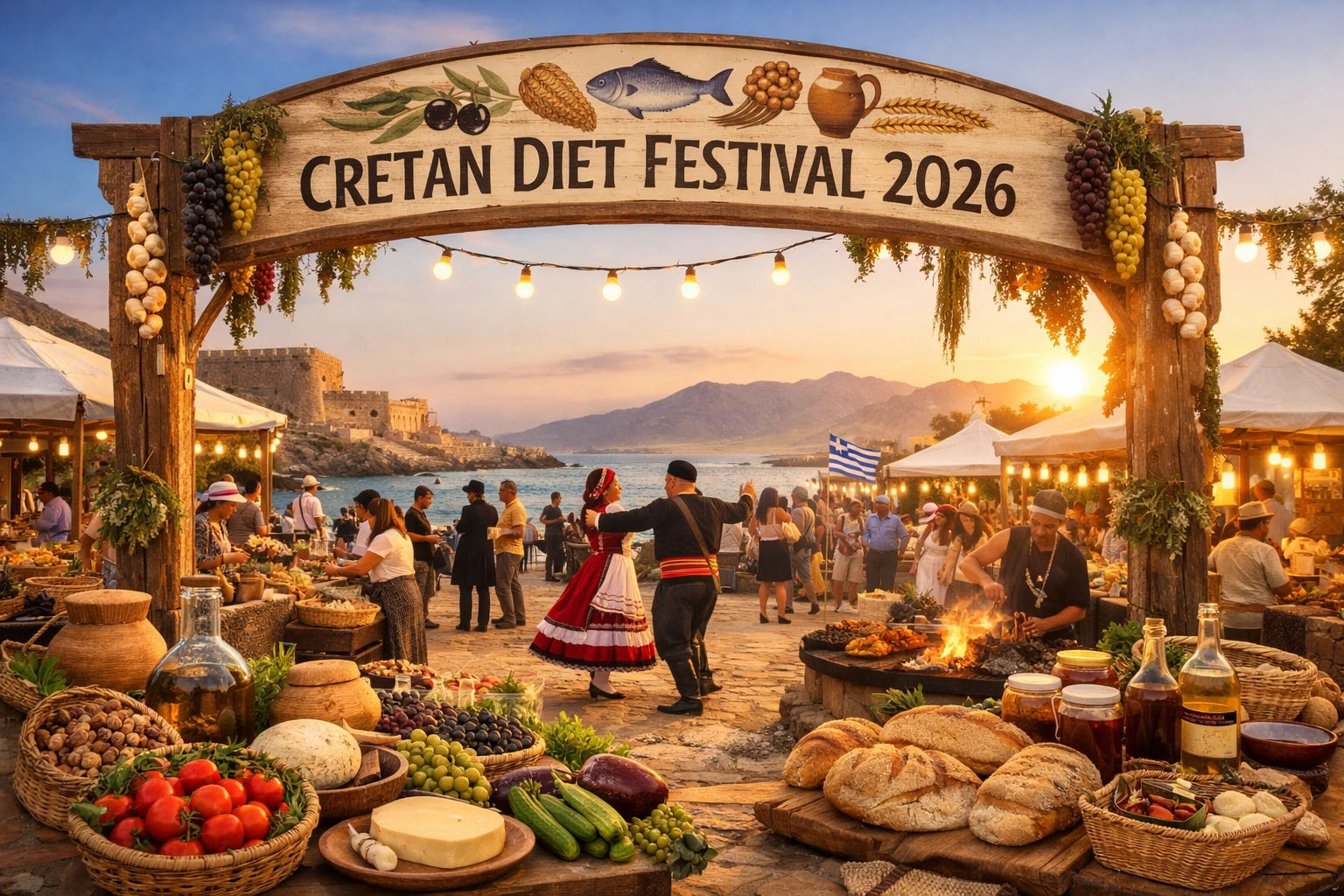
    Cretan Diet Festival 2026
    Food & Culture / Festival
    TBA

    Cretan Diet Festival 2026

    The island of Crete stands unrivaled when it comes to food. Its culinary tradition predates the concept itself: Minoan Cretans were pressing olive oil, cultivating vines, and harvesting wild herbs over four thousand years ago. The essential character of their diet—a blend of olive oil, legumes, fresh vegetables, herbs, fish, and goat and sheep cheese—has barely changed since. The Cretan Diet is not a wellness trend; it is the oldest continuously practiced food culture in Europe. In 2026, Crete carries a new recognition: it has been named the European Region of Gastronomy, the continent's most prestigious culinary designation.

    Into this landmark year arrives the Cretan Diet Festival 2026, returning to the Municipal Garden of Rethymno in early July. This event brings together the island's producers, chefs, winemakers, cheesemakers, and folk artists for a week of tastings, workshops, cooking demonstrations, music, and cultural celebration. It is not merely a farmers' market with a stage; it is a genuine cultural event that celebrates the food traditions of one of the Mediterranean's most significant culinary civilizations.

    "The Cretan Diet is the oldest continuously practiced food culture in Europe."

    The Story of the Cretan Diet

    A UNESCO-backed Mediterranean Model

    Before entering the festival, it helps to understand what the Cretan Diet is and why it matters enough to have a festival named after it. The Cretan Diet is a specific expression of the Mediterranean Diet, inscribed on the UNESCO Intangible Cultural Heritage of Humanity list in 2013. Within the Mediterranean context, the Cretan version holds a special position. The landmark Seven Countries Study conducted by American physiologist Ancel Keys in the 1950s and 1960s identified Cretans as having the lowest rate of cardiovascular disease and one of the longest life expectancies, attributed directly to their diet.

    "The Cretan version of the Mediterranean Diet has always occupied a special position."

    The specific components that make the Cretan Diet distinctive include:

    • Extra-virgin olive oil as the primary fat, with Crete producing approximately 100,000 tonnes annually.
    • Wild greens and herbs, harvested from Cretan hillsides for millennia.
    • Legumes: chickpeas, lentils, fava beans, and black-eyed peas.
    • Whole grains, particularly the iconic dakos rusk.
    • Fresh vegetables and fruits, including Maleme oranges and Gerakario cherries.
    • Fresh and preserved fish, sourced from Crete's 1,000 km coastline.
    • Cretan cheeses, like graviera, a PDO product.
    • Tsikoudia (raki), a PGI-status Cretan grape spirit.
    • Thyme honey, considered among the finest in the world and a PDO product.

    Crete: European Region of Gastronomy 2026

    A Year of Culinary Celebration

    The European Region of Gastronomy designation is awarded by the International Institute of Gastronomy, Culture, Arts and Tourism (IGCAT) to regions demonstrating exceptional food culture, innovation, and sustainable food practices. Crete's designation for 2026 was recognized by Wanderlust Magazine as a major food travel motivation, naming the Cretan Diet Festival as a key event to experience the island's gastronomy firsthand.

    "Crete's food culture forms the heart of the Mediterranean diet and serves as a model for global healthy eating."

    The 2026 designation means that the Cretan Diet Festival carries additional programming ambitions and international visibility, with events and participants from across the continent engaging with Crete's food culture.

    The Festival Experience

    A Week of Culinary and Cultural Immersion

    The Cretan Diet Festival 2026 is organized by the Municipality of Rethymno, the Regional Unit of Rethymno, and the Chamber of Commerce of Rethymno. Based on the confirmed 2025 program and the 2026 framework, the festival takes place in early July at the Rethymno Municipal Garden, running for approximately one week.

    "This is not a supermarket sample table. These are the small-scale farmers, cooperative producers, and artisan food makers of the island."

    The heart of the daytime program is an open-air trade fair of Cretan products. Producers from across the island present their olive oils, wines, cheeses, honeys, rusks, herbs, cured meats, jams, and specialty foods directly to the public. The opportunity to meet a Sitia olive oil producer, taste their different oil varieties, and buy directly is an experience no restaurant visit can replicate.

    The Wines of Crete organization highlights the festival's wine dimension, with seminars where visitors learn about production methods, attributes, quality standards, and health benefits. Cretan wine has experienced a renaissance, with native grape varieties like Vidiano and Kotsifali appearing on wine lists across Europe.

    Workshops and Demonstrations

    Hands-on Culinary Education

    The festival's daily program includes hands-on cooking workshops and chef demonstrations on the main stage. Based on the confirmed 2025 schedule, workshops begin at approximately 7:15 pm and cover topics such as:

    • Cretan paximadi (rusk): making, soaking, and serving this fundamental bread product.
    • Traditional Cretan pastries: kaltsounia, sfakianes pites, and loukoumades.
    • Cheese-making: demonstrations using Cretan sheep and goat milk.
    • Wine and olive oil sensory evaluation: guided tastings with certified producers and sommeliers.

    One highlight is "From Our Land to Your Table," featuring home cooks from southern Rethymno preparing traditional rural dishes. The Agri-Food Partnership of Crete hosts presentations about certified Cretan tavernas and restaurants, helping visitors continue their culinary exploration after the festival.

    Evening Entertainment

    Music and Cultural Performances Under the Stars

    Each evening, the festival's main stage transitions to live cultural performances. Based on the 2025 program, evening entertainment runs from approximately 8:45 pm to 11:00 pm and includes:

    • Traditional Cretan dance performances by local folk associations.
    • Cretan lyra music concerts, featuring the island's defining musical instrument.
    • Contemporary Greek music concerts, such as performances by Eva Politaki and the GreCanto Ensemble.
    • Children's educational and entertainment program, including food education activities and craft workshops.

    The Children's Program

    Engaging the Youngest Food Lovers

    The festival's investment in children's programming is one of its most distinctive features. The confirmed program includes educational activities where children learn about the origins of Cretan food products, participate in simple cooking activities, and engage with the island's food culture in age-appropriate ways. This dimension makes the Cretan Diet Festival genuinely family-friendly.

    Rethymno: The Festival's Extraordinary Setting

    A Historic Venetian City as Backdrop

    The Cretan Diet Festival takes place in the Municipal Garden of Rethymno, a mature urban park in one of the most beautifully preserved Venetian cities in the Mediterranean. Rethymno's old city is a fine example of Venetian urban architecture, with the Venetian Fortress Fortezza, the Venetian Lighthouse, and narrow lanes preserving a concentration of Venetian palazzos, Ottoman fountains, and Byzantine church buildings.

    "You can be watching a cooking demonstration while hearing the evening bells of the Nerantze Mosque from across the garden."

    The Municipal Garden provides a setting that feels simultaneously intimate and civic, perfect for a festival celebrating Crete's culinary heritage. Rethymno's position between Heraklion and Chania makes it centrally accessible for visitors arriving at either of Crete's main airports.

    Practical Guide to Attending

    Making the Most of Your Festival Experience

    Getting to Rethymno is straightforward:

    • Heraklion International Airport (HER): approximately 75 km east of Rethymno.
    • Chania International Airport (CHQ): approximately 75 km west of Rethymno.
    • KTEL Bus: frequent services connect Heraklion and Chania to Rethymno.
    • The Rethymno Municipal Garden is centrally located and walkable from old city accommodations.

    Tickets and admission:

    • Tickets are available at the entrance.
    • The festival has historically been free, with some paid elements.
    • 2026 pricing will be announced by the Municipality of Rethymno; monitor official channels for updates.

    When to go for maximum program:

    • First evening: the opening ceremony and introductory program.
    • Midweek: detailed cooking workshops are typically scheduled mid-festival.
    • Final evening: the festival traditionally closes with a special musical concert.

    Where to stay: Rethymno's old city offers accommodation within a short walk of the Municipal Garden, with options ranging from boutique hotels to family-run guesthouses. Book early for early July, as Rethymno's peak summer season fills quickly.

    Verified Information at a Glance

    • Event Name: Cretan Diet Festival 2026 (Γιορτή Κρητικής Διατροφής)
    • Event Category: Annual food, wine, and culture festival
    • Confirmed Dates: Early July 2026
    • Duration: Approximately 7 days
    • Venue: Municipal Garden of Rethymno, Crete
    • Admission: Tickets at entrance (historically free with some paid elements)
    • Daily Programme: Producers market, workshops, concerts, children's programme
    • Organizers: Municipality of Rethymno, Regional Unit of Rethymno, Chamber of Commerce of Rethymno
    • 2026 Special Context: Crete designated European Region of Gastronomy 2026 by IGCAT
    • Key Food Products Featured: Olive oil (PDO Cretan), graviera cheese (PDO), thyme honey (PDO), tsikoudia/raki (PGI)
    • Official Information: Municipality of Rethymno

    ```

    Rethymno Municipal Garden, Rethymno, Crete
    Jul 1, 2026 - Jul 7, 2026
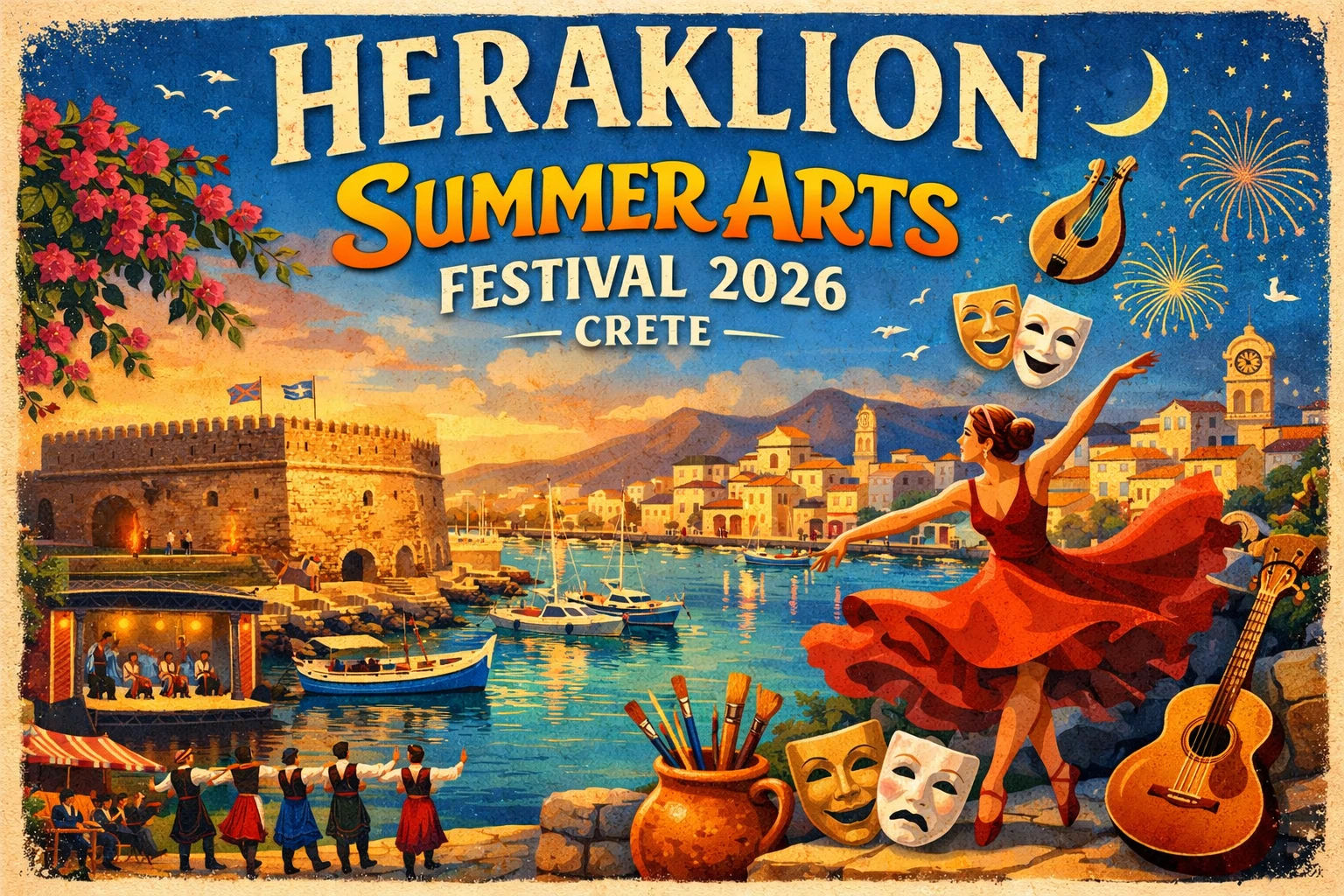
    Heraklion Summer Arts Festival 2026
    Cultural / Performing Arts Festival
    TBA

    Heraklion Summer Arts Festival 2026

    Heraklion Summer Arts Festival 2026: Where Ancient Walls Echo with Living Culture

    Every summer, a remarkable transformation takes place in Heraklion, the capital of Crete and the largest city in Greece's largest island. The Venetian walls that once defended the city against Ottoman siege become open-air concert stages. The Garden Theatres near the old city fill with audiences watching drama, dance, and opera under a sky that stays luminous until well past nine in the evening. The city's streets and squares come alive with music, film projections, and street performance in a seasonal cultural awakening that the residents of Heraklion have come to rely on as one of the defining rituals of their year.

    This is the Heraklion Summer Arts Festival, also known locally as "Heraklion Kalokairi" (Heraklion Summer), organized annually by the Municipality of Heraklion and described by the municipality itself as "a long-standing cultural institution of unfailing impact." In 2026, the festival once again runs from July through mid-September, presenting an extraordinary range of theatrical productions, classical music, contemporary dance, opera, cinema, and Cretan traditional arts across the city's most historically resonant venues.

    At its peak, the festival has programmed more than 200 events in a single season, across more than a dozen venues throughout the city. The 2025 edition featured more than 130 events at the city's landmark outdoor spaces, drawing Greek and international visitors from across the Mediterranean. For any traveler who visits Crete in the summer months and is interested in culture, arts, or simply the experience of watching a world-class theatrical performance inside a 16th-century Venetian fortress, the Heraklion Summer Arts Festival is the most compelling event on the island's calendar.


    The History of the Heraklion Summer Arts Festival

    The Heraklion Summer Arts Festival is not a recent invention. It has been running for several decades, building steadily from a modest municipal program of summer events into what is now one of the most significant annual cultural festivals in Greece outside of Athens and Thessaloniki.

    The festival's founding philosophy, as stated on the official Municipality of Heraklion website, has remained consistent across its history: to "showcase local artistic potential, creativity and the capabilities of people keen to express themselves," while also presenting international-level productions and visiting artists who bring the breadth of European and global cultural life to a Cretan audience. In practice this means a program that runs the full length from children's theatre and traditional Cretan dance to opera, classical ballet, tragedy performances in the ancient tradition, and contemporary dance works that would not look out of place at Edinburgh or Avignon.

    The municipality has also established a strong tradition of including community participation at no cost. A significant proportion of festival events are free to attend, including many outdoor performances at the Venetian Walls venues and public spaces, with voluntary contributions encouraged rather than ticket prices charged. This accessibility philosophy means that the festival functions genuinely as a civic celebration as much as a curated cultural event.


    The Venues: Heraklion's History as Performance Space

    What makes the Heraklion Summer Arts Festival architecturally and experientially unlike almost any other festival in Greece is the quality and historical depth of its venues. Heraklion is a city with more than 3,000 years of continuous habitation, and its built environment layers Minoan, Roman, Byzantine, Arab, Venetian, and Ottoman history into a single city center. The festival uses this layered history not as backdrop but as active participant.


    Nikos Kazantzakis Open-Air Garden Theatre

    The Nikos Kazantzakis Open-Air Theatre (named after Heraklion's most famous son, the author of Zorba the Greek and The Last Temptation of Christ, who was born in Heraklion in 1883) is the festival's central and largest venue. Located within the historic garden at the edge of the Venetian Walls, the theatre hosts the festival's major theatrical and dance productions throughout July and August, including visiting Greek national companies, international dance troupes, and the season's operatic and orchestral concerts.

    The setting, surrounded by mature trees within the fortification complex, creates an acoustic environment that suits both intimate theatrical productions and large orchestral works, and the sight of the audience gathering through the garden as sunset fades over the walls is one of the most quietly spectacular evening rituals in Cretan cultural life.


    Manos Hatzidakis Open-Air Theatre

    The Manos Hatzidakis Open-Air Theatre, named after the celebrated Greek composer whose score for Never on Sunday won the 1960 Academy Award for Best Original Song, is the festival's second garden theatre and the venue for a complementary program of concerts, theatrical productions, and dance performances that runs alongside the Kazantzakis Theatre program. Together, the two garden theatres make it possible for the festival to stage multiple major productions on the same evening, building a program density that a single venue could never support.


    The Venetian Fortress (Koules)

    The Venetian Fortress of Heraklion, known locally as Koules (Κούλες), sits at the entrance to Heraklion's old harbour, its massive stone bulk projecting into the sea on a promontory that has been fortified since at least the Byzantine period. The current structure was built by the Venetians between 1523 and 1540, and for much of the fortress's history it served as the primary defensive anchor of Venetian Crete. Today, its broad upper terrace and internal spaces serve as one of the most memorable outdoor performance venues in Greece: the sea visible on three sides, the harbour lights reflected in the water below, and a stone stage that has stood for nearly 500 years. Opera performances, orchestral concerts, and major theatrical productions staged at Koules during the Summer Arts Festival are among the most visually extraordinary performance events in the entire eastern Mediterranean.


    The Venetian Walls Venues: Vittouri Gate, Jesus Gate, and the Makassi Arch

    The Venetian Walls of Heraklion, built over the course of the 16th and 17th centuries and considered the most significant example of Venetian military architecture in the Aegean, encircle the old city with a perimeter of approximately 4 kilometers. The Summer Arts Festival uses multiple points along the walls as performance spaces, including the Vittouri Gate, the Jesus Gate, the Makassi Arch, and the ramparts and low squares built into the wall's internal structure.

    These wall-based venues serve as the setting for the "Kathodon" Street Arts Festival, which runs for approximately 14 days in June and serves as the opening dimension of the broader summer cultural season. Kathodon transforms the areas within and around the Venetian Walls into a canvas for street art, graffiti, breakdance, DJ performances, and outdoor projection, bringing the youthful and contemporary dimension of Heraklion's cultural life into conversation with its ancient architectural context.


    Municipal Summer Cinema Bethleem

    The Municipal Summer Cinema "Bethleem" is the festival's open-air cinema venue, screening films throughout the summer months in the tradition of the Greek outdoor cinema (therinocinema) that has been a cornerstone of warm-weather cultural life across Greece for over a century. The combination of the warm Cretan evening, the open sky, and the film program curated as part of the Summer Arts Festival creates an experience that is irreplaceable for visitors who find that the most honest cultural immersion comes not from attending a headline concert but from sitting in a garden with locals watching a film at midnight.


    What the 2026 Program Offers: The Full Cultural Spectrum

    Based on the well-established annual framework of the festival and the Municipality of Heraklion's stated programming philosophy, the 2026 Heraklion Summer Arts Festival will once again offer:

    • Ancient drama (tragedy and comedy) at the garden theatres, drawing on Greece's unbroken theatrical tradition since the 5th century BCE
    • Classical ballet and contemporary dance performed by visiting Greek national companies and international troupes
    • Opera and oratorio productions at Koules and the Kazantzakis Theatre
    • Children's theatre for family audiences, integrated into the main program throughout July and August
    • Modern theatre: productions from contemporary Greek playwrights and translated international works
    • Orchestral and chamber music concerts: the festival has hosted international orchestras alongside the Heraklion Municipality Philharmonic and the Youth Symphony Orchestra of Crete
    • Cretan traditional music and dance: honoring the island's living folk heritage with performances that reflect the specific regional identity of Cretan culture
    • Street art and performance (Kathodon, June, with programming continuing into the summer months)
    • Open-air cinema at the Municipal Cinema Bethleem

    The 2025 edition featured more than 130 events, and previous editions have reached a record 200 events in a single season. The 2026 program will be announced through the official Municipality of Heraklion website (heraklion.gr) and its cultural channels, typically several weeks before the July opening.


    The Crete Festival: A Parallel Regional Event that Complements the Summer Arts Festival

    Running alongside the Municipality's program throughout June to September, the Crete Festival, organized by the Region of Crete since 2021, presents concerts and theatrical performances at archaeological and religious sites across the entire island, connecting contemporary culture with Crete's ancient monuments.

    In recent editions, the Crete Festival has included concerts at the Eleftherna Archaeological Museum, the Knossos Archaeological Site, and other sites across all four regional units of Crete. The festival's commitment to staging cultural events at Crete's most historically significant archaeological sites creates programming moments that exist nowhere else in the world: a concert of Greek music in the landscape that was once the center of Minoan civilization, the oldest European high culture, active from approximately 3,000 BCE.

    For visitors to Heraklion in summer 2026, the combination of the Municipal Summer Arts Festival and the Region-wide Crete Festival provides a cultural program of exceptional density and variety, running simultaneously from multiple organizational sources across the city and island.


    Heraklion Beyond the Festival: What the City Offers Summer Visitors

    The Heraklion Archaeological Museum

    The Heraklion Archaeological Museum is the finest collection of Minoan art in the world and one of the most important archaeological museums in Europe, housing artifacts including the Phaistos Disc (a 3,700-year-old fired clay disc inscribed with an undeciphered script), the Snake Goddess figurines, and the extraordinary Minoan frescoes from the palace of Knossos. Many Summer Arts Festival visitors build their first morning around the museum before the evening theatrical program begins, using the daytime heat as a reason to be indoors with some of the most extraordinary objects from the ancient world.


    The Palace of Knossos

    Knossos, the largest Minoan palatial site in Crete, sits approximately 5 kilometers south of Heraklion's city center and is accessible by city bus. The site, inhabited from approximately 7,000 BCE and at its peak the center of a Mediterranean-wide trading network, covers approximately 20,000 square meters of excavated palace architecture. Visiting Knossos in the morning, then attending a theatrical production at the Nikos Kazantzakis Theatre in the evening, creates a cultural day of extraordinary range: you move from the 15th century BCE to the present in the span of a single bus ride and an evening walk.


    Heraklion's Market and Food Culture

    Heraklion's Central Market, the covered market on 1866 Street, is one of the most authentic and still-functioning traditional markets in urban Greece. Cretan food culture, widely considered among the healthiest diets in the world and a significant component of the Mediterranean Diet's UNESCO recognition, is represented across the market's stalls in the form of Cretan extra-virgin olive oil, graviera and kefalotyri cheeses, thyme honey, dried herbs, and the island-specific rusks known as dakos. A morning at the market before an afternoon at Knossos and an evening at the Summer Arts Festival is the most complete single day that Heraklion offers.


    Practical Travel Guide for Heraklion Summer Arts Festival 2026

    Getting to Heraklion

    Heraklion International Airport (Nikos Kazantzakis, HER) is Greece's second busiest airport, receiving direct flights from Athens, Thessaloniki, and major European airports including London Gatwick and Heathrow, Amsterdam Schiphol, Frankfurt, Paris CDG, Rome Fiumicino, and Vienna. Summer season flight capacity to Heraklion is extensive, with carriers including Olympic Air, Aegean, Ryanair, easyJet, and Lufthansa all serving the route.

    Overnight ferries from Piraeus (Athens) arrive at Heraklion port, approximately 500 meters from the old city center, after an 8 to 9-hour crossing.


    Tickets and Practical Details

    • Ticket availability: tickets for paid events are normally available 7 days in advance from the Municipality Box Office at the Nikos Kazantzakis Garden Theatre or from Dokimakis Bookstore at Kantanoleon 4, Heraklion
    • Many events are free: outdoor wall venue events, street performances, and community concerts within the festival program are free of charge
    • Program announcements: the full 2026 program is announced on the Municipality of Heraklion's official website (heraklion.gr/en/culture)
    • Evening dress: Heraklion in July and August is warm until midnight; light summer clothing is appropriate for all outdoor festival venues


    Where to Stay in Heraklion

    The old city center and the harbour area place visitors within walking distance of Koules, the Garden Theatres, the Central Market, and the main festival venues. Hotels in the area around the Morosini Fountain (the most photographed landmark in central Heraklion, built in 1628 by Venetian governor Francesco Morosini) are particularly well positioned for festival access.


    Verified Information at a Glance

    Item: Confirmed details

    Event name: Heraklion Summer Arts Festival 2026 ("Heraklion Kalokairi" / Summer in Heraklion)

    Event category: Annual municipal multi-arts summer festival: theatre, opera, dance, classical music, cinema, street arts

    Confirmed dates: July to mid-September 2026 (specific program to be announced; framework confirmed annually)

    Number of events (typical): 130 to 200+ events per season

    Main venues: Nikos Kazantzakis Open-Air Garden Theatre, Manos Hatzidakis Open-Air Theatre, Venetian Fortress (Koules), Venetian Walls (Vittouri Gate, Jesus Gate, Makassi Arch), Municipal Summer Cinema Bethleem

    Admission: Mix of ticketed performances and free outdoor events (50+ free performances in recent editions)

    Ticket availability: Available 7 days before each performance from Municipality Box Office at the Kazantzakis Garden Theatre or Dokimakis Bookstore, Kantanoleon 4, Heraklion

    Organizer: Municipality of Heraklion

    Official information: heraklion.gr/en/culture/heraklion-kalokairi

    Complementary event: Crete Festival (Region of Crete), archaeological site concerts June to September across Crete

    Street arts component: Kathodon Street Arts Festival, June, 14 days, Venetian Walls and city streets

    Nearest airport: Heraklion International Airport (HER) / Nikos Kazantzakis, approximately 5 km from city center


    When the Nikos Kazantzakis Theatre fills on a July evening and the audience settles into the garden seats as the last light fades from the Venetian Walls above, with a program that might move from ancient Sophocles to contemporary Greek dance to a symphony orchestra in the span of a single week, the Heraklion Summer Arts Festival delivers an experience that places you simultaneously inside one of the most historically layered cities in the Mediterranean and at the living heart of a cultural tradition that has been producing great art without interruption since the Minoan palace at Knossos was the center of a civilization. Heraklion in the summer of 2026 is precisely where you want to be if culture, history, and the warmth of a Cretan evening mean anything to you.

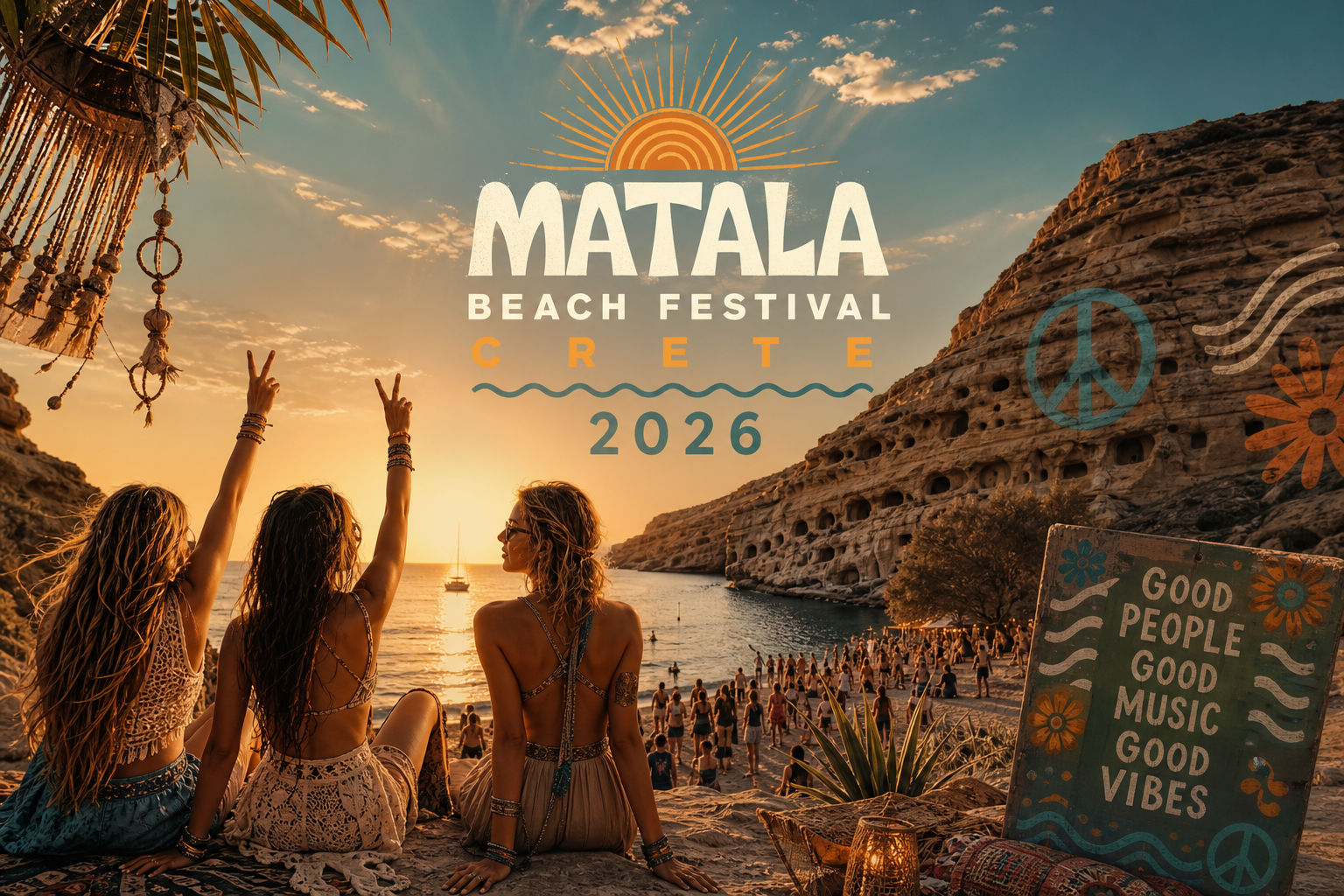
    Nikos Kazantzakis Open-Air Theatre & Manos Hatzidakis Open-Air Theatre, Heraklion, Crete
    Jul 1, 2026 - Sep 15, 2026
    Mirabello Festival 2026
    Cultural Festival / Arts
    TBA

    Mirabello Festival 2026

    There is a bay in eastern Crete that has been stopping people in their tracks for centuries. The Gulf of Mirabello, whose name the Venetians gave it and which translates simply as "beautiful view," stretches across the northeastern coast of the island in a sweep of deep blue water framed by mountains, olive groves, and the ghost of the ancient island fortress of Spinalonga rising from the water to the north. At the heart of this extraordinary setting sits Agios Nikolaos, the cosmopolitan, culturally rich capital of the Lasithi region, and every summer it comes alive with a season of events, performances, concerts, and culinary celebrations collectively known as the Mirabello Festival.

    The Mirabello Festival is not one event with a single date. It is a season of cultural life that unfolds across the summer and early autumn months in Agios Nikolaos and its surrounding region, drawing on the extraordinary concentration of artistic, musical, culinary, and traditional culture that this part of Crete has always nurtured. In 2026, the festival season runs from July through September, with the flagship Mirabello Jazz Festival, the Lato Cultural Festival peaking in July and August, and the Cretan Street Food Festival anchoring the programme in late September. Taken together, these events make the Mirabello region one of the most compelling cultural destinations in the entire Mediterranean during the summer months.

    "The Gulf of Mirabello provides a natural stage that amplifies every performance with its sheer visual grandeur."

    What Is the Mirabello Festival?

    A Season of Culture Built Around the World's Most Beautiful Bay

    The "Mirabello" brand in Agios Nikolaos refers to the annual summer cultural programme organized by the Municipality of Agios Nikolaos and various cultural associations and partners across the Lasithi Prefecture. The programme encompasses multiple distinct events across different disciplines, all united by their location on the Gulf of Mirabello and their celebration of the extraordinary cultural layering of this corner of Crete.

    The key components of the 2026 Mirabello Festival season are:

    • Mirabello Jazz Festival: The flagship music event that has made Agios Nikolaos a destination for jazz lovers from across Greece and beyond, attracting musicians and audiences of international caliber to venues on the waterfront and in the town's squares and cultural spaces
    • Lato Festival: Named after the ancient Dorian city of Lato that stands above the village of Kritsa, this multi-discipline arts and performance festival runs through July and August, presenting concerts, theatrical performances, art exhibitions, dance, and photography against the backdrop of the Mirabello bay
    • Cretan Street Food Festival (7th Edition): A celebration of Cretan gastronomy organized by the Municipality of Agios Nikolaos around World Tourism Day in late September, held at Kitroplateia (the town's central square on the waterfront), bringing together hotels, restaurants, wineries, cheesemakers, and culinary schools under the theme of Cretan cuisine in all its contemporary creativity
    • Cretan Music Festival: A multi-day music celebration organized in collaboration with the Association of Primary Education Teachers of Mirabello, showcasing the living tradition of Cretan folk music in an educational and performance context

    The Mirabello Jazz Festival: Music Against the Aegean Sky

    Why Jazz Found a Home in Agios Nikolaos

    The Mirabello Jazz Festival is the international cultural flagship of the summer season in Agios Nikolaos. It is a testament to the particular sophistication of this town that jazz, the most cerebral and emotionally complex of popular music forms, has found such a lasting and enthusiastic home here on the Gulf of Mirabello.

    Agios Nikolaos has always attracted a cosmopolitan, culturally engaged visitor who wants more from a Greek island holiday than beaches and taverna mezes, though it delivers both of those superbly. The town's natural amphitheatre of waterfront terraces, open squares, and the extraordinary lake that sits at its center (Lake Voulismeni, the mythological bathing pool of Athena and Artemis) provides outdoor performance spaces of genuine quality and unforgettable atmosphere.

    "Jazz fans planning a Crete visit in July or August 2026 should monitor the official Agios Nikolaos website at agiosnikolaos.city and the Visit Agios Nikolaos social media channels for the confirmed lineup and performance dates."

    The Lato Festival: July and August Cultural Programming

    Concerts, Theatre, Dance, and the Living Arts of Eastern Crete

    The Lato Festival takes its name from ancient Lato, one of the finest and least-visited Dorian archaeological sites in Crete, which sits above the village of Kritsa on a ridge with views that stretch from the Gulf of Mirabello to the Aegean. This naming choice is deeply intentional. The festival connects the living cultural life of modern Agios Nikolaos directly to the ancient heritage of the Lasithi region, presenting contemporary and traditional performance in a landscape where culture has been accumulated for more than three millennia.

    The Lato Festival peaks in July and August 2026 and offers a genuinely eclectic programme across disciplines:

    • Concerts featuring both locally rooted and internationally renowned performers, with Cretan traditional music, classical performance, world music, and contemporary genres all represented across the festival calendar
    • Theatrical performances drawing on both Greek drama in its classical form and contemporary Cretan and Greek theatrical work
    • Dance performances encompassing traditional Cretan folk dance alongside contemporary choreography
    • Photography exhibitions that use the gallery spaces of Agios Nikolaos to document and celebrate the landscape, culture, and daily life of the Mirabello region
    • Sporting events and outdoor cultural experiences that use the bay, the surrounding mountains, and the town's public spaces as their stage

    The Cultural Geography That Makes Mirabello Unique

    Discover the Rich Heritage of the Lasithi Region

    The cultural context that surrounds the Lato Festival deserves particular attention for visitors who want to understand what makes the Mirabello region so extraordinary. The Lasithi Prefecture and the Gulf of Mirabello are home to an exceptional concentration of historical and natural heritage within a very compact geographical area.

    Within an hour's drive of Agios Nikolaos, visitors can experience:

    • Ancient Lato: A superbly preserved Dorian city of the 7th to 4th centuries BC, with a civic agora, council chamber, prytaneion, and residential quarters arranged across twin hilltops with views across the entire Gulf of Mirabello
    • Spinalonga Island: The legendary Venetian fortified island and its later role as one of the last active leprosy colonies in Europe (1903 to 1957), made internationally famous by Victoria Hislop's novel "The Island." Accessible by short boat crossing from Elounda or Plaka
    • Kritsa Village: One of the most beautifully preserved traditional Cretan villages, known for its handwoven textiles, the Church of Panagia Kera with its extraordinary 13th-century Byzantine frescoes, and the gorge that connects it to the Lato archaeological site above
    • Lasithi Plateau: The extraordinary circular plateau at 800 to 900 meters elevation, ringed by mountains, dotted with windmills, and home to the Diktaion Andron, the mythological birthplace of Zeus
    • Elounda: The most exclusive resort enclave in Greece, hosting the island's premier five-star hotels with private island villas and a standard of hospitality that has attracted heads of state and global cultural figures for decades

    The Cretan Street Food Festival: September Gastronomy Celebration

    Where the "Flavors of Mirabello" Come to Life

    As the summer heat softens into September's golden warmth, the Mirabello Festival season reaches its culinary climax at the Cretan Street Food Festival, organized by the Municipality of Agios Nikolaos to mark World Tourism Day in late September 2026. This annual event takes place at Kitroplateia, the beautiful central square of Agios Nikolaos that descends to the edge of the harbor and provides one of the most atmospheric outdoor event spaces in Crete.

    The Street Food Festival transforms Kitroplateia into an open-air kitchen and tasting floor where the full ecosystem of Cretan gastronomy is on display:

    • Hotels and restaurants presenting signature dishes made from local Lasithi ingredients
    • Wineries from across eastern Crete, where the indigenous Vilana, Dafni, and Kotsifali varieties produce wines of remarkable character
    • Local cheesemakers presenting the extraordinary range of Cretan dairy culture, from the fresh soft myzithra to the aged graviera that is one of Greece's most celebrated cheeses
    • Culinary schools and students presenting contemporary reinterpretations of Cretan traditional recipes
    • Women's cultural associations and community groups presenting the home-cooking traditions that define Cretan hospitality at its most genuine

    The 2025 edition of this festival, the 6th, introduced a competitive element with the theme "Flavors of Mirabello", in which young chefs, associations, and schools competed to best capture the essence of Cretan cuisine in creative new preparations. Winning recipes were adopted by local restaurants and served with the creators' names attached, creating a direct legacy connection between the festival competition and the living culinary culture of the region.

    "The 2026 edition is expected to follow the same format with updated themes."

    Cretan Music Festival: The Living Tradition of Lyra and Laouto

    A Multi-Day Celebration of Crete's Most Distinctive Art Form

    Woven through the summer Mirabello cultural calendar is the Cretan Music Festival, organized in collaboration with the Association of Primary Education Teachers of Mirabello and the Lasithi Plateau. This multi-day festival positions traditional Cretan music not as a heritage preservation exercise but as a living, breathing, evolving art form that remains central to everyday cultural life in the region.

    Cretan music is among the most distinctive folk music traditions in Europe. Built around the three-stringed bowed lyra and the long-necked laouto, its musical vocabulary encompasses the deeply emotional mantinades (rhyming couplets improvised and sung in call-and-response format), the fast rhythmic patterns of dance music for the pentozalis and sousta, and the more contemplative rizitika, traditional narrative songs of the western Cretan mountains that UNESCO has recognized as an Intangible Cultural Heritage of humanity.

    "Hearing this music performed at an outdoor festival in Agios Nikolaos on a summer evening, with the Gulf of Mirabello shimmering behind the stage and the mountains of the Lasithi range turning purple in the dusk, is an experience that does not age and does not become familiar no matter how many times you encounter it."

    Practical Information for Festival Visitors in 2026

    Travel Tips for the Mirabello Summer Season

    The Gulf of Mirabello region is accessible from two airports: Heraklion Nikos Kazantzakis International Airport (HER), located approximately 65 km west of Agios Nikolaos and served by direct flights from across Europe, and Sitia Public Airport (JSH), located approximately 70 km east with smaller regional connections. Car hire from either airport is the most practical arrangement for exploring the full range of Mirabello Festival venues across the region.

    Agios Nikolaos sits 65 km east of Heraklion along the E75 coastal highway, a drive of approximately one hour. The road itself is one of the most scenic coastal drives in Crete, passing through the vineyards of Peza, the beaches of Istron and Kalo Chorio, and the outskirts of the resort strip of Elounda before reaching the town.

    Practical considerations for the 2026 festival season:

    • July and August are peak season months in Agios Nikolaos, with accommodation filling quickly and prices at their highest. Book at least two to three months in advance for the Lato Festival peak period
    • September offers outstanding value, with warm sea temperatures (reaching their highest of the year), significantly reduced accommodation prices, and the festival calendar still active with the Street Food Festival in late September
    • The Mirabello app, available via the official Agios Nikolaos city website, provides a real-time cultural events calendar for the region and is the most efficient way to track the full festival programme during a visit
    • Free events dominate the festival calendar. The Cretan Music Festival, open-air Lato Festival concerts, and the Street Food Festival at Kitroplateia are all free public events. The Jazz Festival may carry ticketed elements for headline performances

    Where to Stay in Agios Nikolaos for the Festival Season

    Accommodation Options for Every Taste and Budget

    Accommodation in and around Agios Nikolaos covers every price point from budget guesthouses in the town's old quarter to five-star resort hotels on the Gulf of Mirabello:

    • In Agios Nikolaos town center: Walking distance to all festival venues at Kitroplateia, the harbor, and the lake. The town's boutique hotels and guesthouses provide the most culturally immersive base for festival attendance
    • Elounda (12 km north): The prestige resort destination of the Gulf of Mirabello, home to several internationally ranked five-star properties with private beaches and extraordinarily beautiful bay views
    • Istron and Kalo Chorio (10 km west): Quieter beach areas with excellent apartment and studio accommodation at mid-range prices, convenient for day visits to Agios Nikolaos festival events

    An Invitation Written in Music, Food, and Blue Water

    The Mirabello Festival Experience Awaits

    The Mirabello Festival 2026 is not one night on one stage. It is a whole season of cultural life unfolding across one of the most beautiful natural settings in the Mediterranean, through the warmest months of the year, in a community that has been hosting culture with genuine warmth and seriousness since before recorded history began.

    From the Jazz Festival's sophisticated international performances to the lyra and laouto of the Cretan Music Festival, from the theatrical and dance programming of the Lato Festival through July and August to the extraordinary open-air kitchen of the September Street Food Festival at Kitroplateia, the Gulf of Mirabello in 2026 offers a depth of cultural experience that few island destinations anywhere in the world can match.

    The bay is extraordinarily beautiful, the people are genuinely warm, the food is among the finest in the Mediterranean, and the music will stay with you long after you have left. The Mirabello season is already underway. Make sure you are part of it.

    Frequently Asked Questions

    The Things People Always Want to Know

    What is the Mirabello Festival in Crete?

    The Mirabello Festival is the annual summer cultural programme organized in Agios Nikolaos and the Gulf of Mirabello region of eastern Crete. It encompasses multiple events including the Mirabello Jazz Festival, the Lato Festival (July to August), the Cretan Music Festival, and the Cretan Street Food Festival (late September). The programme is organized by the Municipality of Agios Nikolaos and various cultural partners.

    When does the Mirabello Festival take place in 2026?

    The Mirabello Festival season in 2026 runs from July through September. The Lato Festival peaks in July and August. The Mirabello Jazz Festival takes place across the summer months. The Cretan Street Food Festival takes place in late September 2026 at Kitroplateia in Agios Nikolaos to mark World Tourism Day. Specific event dates are published through the official Agios Nikolaos city website and the Mirabello app.

    Where do the Mirabello Festival events take place in Agios Nikolaos?

    Principal venues include Kitroplateia (the central waterfront square, primary venue for the Street Food Festival and outdoor performances), the harbourfront of Agios Nikolaos, Lake Voulismeni and its surrounding terraces, and various open-air cultural spaces across the town and surrounding Lasithi region.

    Is the Mirabello Festival free to attend?

    Most Mirabello Festival events are free public events, including the Cretan Street Food Festival at Kitroplateia, open-air Lato Festival concerts, and Cretan Music Festival performances. Some Jazz Festival headline events may carry ticketing. Check the official programme at agiosnikolaos.city and the Mirabello app for specific event pricing as it is announced.

    How do I get to Agios Nikolaos for the Mirabello Festival 2026?

    Fly into Heraklion Nikos Kazantzakis International Airport (HER), approximately 65 km west of Agios Nikolaos, served by direct flights from across Europe. Alternatively, Sitia Airport (JSH) is approximately 70 km east for smaller regional connections. A hire car from either airport is the most practical option, with the drive from Heraklion to Agios Nikolaos taking approximately one hour along the E75 coastal highway.

    Verified Information at a Glance

    • Festival Name: Mirabello Festival / Mirabello Events Agios Nikolaos 2026
    • Event Category: Summer Cultural Festival / Multi-Discipline Arts, Music, and Gastronomy Season
    • Season Dates: July through September 2026
    • Key Events Within the Season:
    • Lato Festival: peaks July and August 2026
    • Mirabello Jazz Festival: July/August 2026 (exact dates to be confirmed)
    • Cretan Music Festival: Summer 2026 (dates to be confirmed)
    • Cretan Street Food Festival (7th Edition): late September 2026, Kitroplateia, Agios Nikolaos
    • Primary Location: Agios Nikolaos, Lasithi Prefecture, Eastern Crete, Greece
    • Key Venues: Kitroplateia (central waterfront square); Lake Voulismeni; Agios Nikolaos Harbourfront; various open-air cultural spaces
    • Organizer: Municipality of Agios Nikolaos, in partnership with cultural associations
    • Street Food Festival Contact: +30 28410 89513 / tourismos@dimosagn.gr
    • Official Website: agiosnikolaos.city
    • Official App: Mirabello App (available via agiosnikolaos.city)
    • Nearest Airport: Heraklion Nikos Kazantzakis International Airport (HER), 65 km west of Agios Nikolaos
    • Admission: Majority of events are free to the public

    ```

    Agios Nikolaos, Elounda & Mirabello Bay, Crete, Greece, Crete
    Jul 1, 2026 - Sep 30, 2026
    AKRA Improvised Music Festival – Heraklion 2026
    Music / Experimental / Jazz
    TBA

    AKRA Improvised Music Festival – Heraklion 2026

    AKRA Improvised Music Festival 2026 – Heraklion, Crete: Where the Venetian Walls Become a Canvas for Sound

    Some of the best musical experiences in the world have no set list. No rehearsed structure, no predetermined sequence of notes, no final chorus you know is coming before it arrives. The music simply begins somewhere, moves through an hour of invention, surprise, friction, and resolution, and ends in a place that nobody in the room, including the musicians, could have predicted when the first note sounded.

    This is what improvised music is, and this is what the AKRA Improvised Music Festival brings to the Venetian Walls of Heraklion on Crete's island on the 4th and 5th of July 2026. Two days of free improvisation, contemporary experimental sound, and the kind of musical risk-taking that most festivals are too commercially cautious to program, staged inside one of the most historically layered architectural environments in the eastern Mediterranean.

    The festival's own statement of intent is worth quoting directly: "At the edges where things begin and end, improvisation emerges." For a music festival, that is an unusually honest and precise description of what it is actually doing. AKRA is not trying to entertain you in the conventional sense. It is inviting you to stand at an edge, listen to what musicians do when they have no safety net, and find out whether you are someone who finds that experience thrilling or confusing. Most people who attend once discover they find it thrilling.


    What AKRA is: A New Kind of Festival Rooted in an Ancient City

    AKRA (Άκρα in Greek) means "edge," "extremity," or "headland" in classical and modern Greek. The word captures both a geographic idea, a promontory jutting into the sea, which is exactly what Heraklion's waterfront does along its harbor entrance, and a conceptual one: the edge of musical convention, the point where the known structure ends and free creation begins.

    The festival describes itself as "a two-day festival dedicated to improvised music and contemporary experimental sound, rooted in the Venetian Walls of Heraklion." This language is careful and specific. It is not a jazz festival in the conventional sense, though improvised music and jazz share deep historical roots. It is not an experimental electronic festival, though some of the music played under its umbrella will use electronics. It is a festival specifically organized around the act of improvisation itself, which is the oldest and most fundamental form of musical performance and the one most profoundly suppressed by the conventions of contemporary commercial music culture.

    AKRA's institutional home within the cultural life of Heraklion, a city that already sustains one of the richest summer cultural programs in Greece through the Heraklion Summer Arts Festival, positions it as a focused and artistically specific counterpoint to the broader municipal program: a two-day deep dive into one of the most challenging and rewarding forms of live music, using the same extraordinary physical setting that the city's larger festivals have established as a performance landscape.


    The Venue: Inside the Venetian Walls of Heraklion

    The choice of the Venetian Walls of Heraklion as AKRA's venue is one of the most musically and historically resonant venue decisions of any festival in Greece.

    The Venetian Walls (Ενετικά Τείχη Ηρακλείου) are among the most significant examples of Renaissance military engineering anywhere in Europe. Constructed between the 1420s and the 1640s by Venetian military engineers, including the brilliant Michele Sanmichele who also designed the Chania fortifications, the walls encircle the old city with a perimeter of approximately 4 kilometers, rising to heights of up to 29 meters at their most massive bastions. They were designed by the Republic of Venice to defend its most important eastern Mediterranean possession against Ottoman attack, and they succeeded in doing so for an extraordinary period: the Siege of Heraklion from 1648 to 1669 lasted 21 years, the longest siege in recorded history, before the city eventually fell.

    Today, these walls stand fully preserved and accessible to the public, integrating into the city's daily life in a way that few historic fortifications anywhere in Europe manage. The venues used for cultural events within and adjacent to the walls include the Vittouri Gate, the Jesus Gate, the Makassi Arch, the Garden Theaters, and the ramparts and low interior squares built into the wall structure. AKRA uses these spaces not as a backdrop but as an acoustic and atmospheric environment: music improvised in a space that has absorbed 600 years of human history sounds different from music improvised in a purpose-built concert hall, and the festival's organizers understand this.

    The Instagram post announcing the 2026 edition describes the festival as moving "from stone to sound, from Aspendos to now," referencing the ancient Turkish amphitheater as a meditation on how stone spaces have always been the setting for live musical performance. In Heraklion's Venetian Walls, AKRA has found a specific and extraordinary version of that ancient relationship between architecture and music.


    The Music: What Improvised and Experimental Sound Means in Practice

    Visitors who are new to improvised music sometimes approach it with uncertainty, unsure of whether they are supposed to understand a framework that their listening experience has not prepared them for. The answer, which every improvised music festival eventually communicates to its new audiences, is that improvised music requires no prior knowledge, no theory background, and no ability to recognize its references. What it requires is a willingness to listen without anticipation.

    The global tradition of free improvisation that AKRA draws on includes several distinct tributaries:

    Free Jazz, which emerged in the United States in the early 1960s through musicians including Ornette Coleman, Cecil Taylor, Albert Ayler, and Archie Shepp, who collectively challenged the harmonic and rhythmic conventions of bebop and created music that prioritized collective spontaneity over predetermined structure. Coleman's 1960 album Free Jazz: A Collective Improvisation gave the movement its name and established the basic paradigm that AKRA builds on: a group of musicians playing simultaneously without a pre-agreed framework, listening intensely to each other, creating form in real time.

    European Free Improvisation, which developed from the late 1960s in the UK, Germany, and the Netherlands through musicians including Derek Bailey, Peter Brötzmann, Han Bennink, and the AMM collective, took the American free jazz impulse and pushed it toward even greater abstraction, removing the last vestiges of blues and swing from the music and creating a purely European improvisational language rooted in contemporary classical music and live electronic experimentation.

    Mediterranean and Greek improvised music: Greece has its own deep improvisational tradition rooted in the makam (modal) structures of Byzantine and Ottoman music, the taksim (solo improvisation) tradition of the urban Greek rebetiko genre, and the more recent work of Greek musicians who have engaged with both the European free improvisation tradition and the specific modal language of Greek and Middle Eastern music. In Heraklion specifically, the Cretan lyra tradition itself contains a strong improvisational dimension, as the best lyra players have always understood the instrument as a vehicle for spontaneous melodic invention within traditional modal frameworks.

    AKRA 2026 brings all of these tributaries into a two-day program staged on an island that itself represents a historical crossroads between European, Byzantine, Ottoman, and Mediterranean musical cultures. The combination is not coincidental.


    The 2026 Edition: What We Know

    The AKRA Improvised Music Festival 2026 is confirmed for Saturday, July 4 and Sunday, July 5, 2026, at the Venetian Walls of Heraklion, Crete.

    The festival announced its 2026 dates in early January 2026, with an atmospheric promotional image created by artist Maria Prokopaki, whose visual contribution to the festival reflects the same commitment to contemporary artistic craft that the music program embodies. The announcement was described by one of the organizers as a "huge announcement" and "something big is coming to Heraklion this summer," indicating that the 2026 edition is planned at a scale that exceeds previous editions.

    The festival's visual identity is built around the concept of edges, specifically the edge between sound and silence, between structure and freedom, and between the ancient stone of Heraklion's walls and the living sound produced within them. These are not abstract artistic concepts for this festival: they describe literally what happens when a musician stands in a space that has been acoustically alive for six centuries and begins to play without a predetermined plan.

    The full lineup for AKRA 2026 had not been formally published at the time of writing, with the organizing team indicating that full artist announcements would follow through the festival's official channels. Following @akra.her on Instagram and the AKRA Festival Facebook page provides the most direct route to lineup announcements as they emerge.


    AKRA in the Context of Heraklion's July Cultural Season

    AKRA 2026 falls on July 4 to 5, which places it at the opening of Heraklion's fullest cultural season.

    On the same weekend, Calvi on the Rocks in Corsica would have run (had it not been cancelled in 2026), and several other Mediterranean music festivals are in full swing. Within Crete specifically, the Cretan Diet Festival opens in Rethymno in early July, and the Kornaria Festival in Sitia is entering its main phase. Heraklion's Heraklion Summer Arts Festival is beginning its July program at the Nikos Kazantzakis and Manos Hatzidakis Garden Theatres.

    For a visitor to Crete who plans a July visit around the cultural calendar, the first weekend of July in Heraklion offers a remarkable pairing: AKRA's two days of improvised music at the Venetian Walls, followed by the broader Summer Arts Festival's theater and classical music program throughout July, provides a cultural itinerary of exceptional range and depth in a single city.


    Why Improvised Music and Why Heraklion

    There is a philosophical dimension to AKRA's existence in Heraklion that is worth acknowledging directly.

    Crete is the island where European civilization has its deepest roots. The Minoan civilization, which flourished from approximately 3000 BCE to 1100 BCE, predates classical Greece by over a millennium and represented the first high culture on European soil. The Minoans were traders, artists, seafarers, and builders, and they were improvisers in the broadest sense: a civilization that was inventing its own forms, structures, and expressions as it went, without a prior model to copy.

    Heraklion, which sits above the ruins of Knossos at a mere 5 kilometers' distance, and whose own layers of history span Byzantine, Arab, Venetian, Ottoman, and modern Greek culture, is a city that has absorbed and processed multiple civilizational influences over four thousand years without losing its specific Cretan identity. Improvisation, in music and in culture, is precisely this process: the ability to absorb influences, respond to the present moment, and produce something new without losing the essential thread of who you are.

    AKRA takes this city and this island as its physical and conceptual home for exactly these reasons.


    Practical Guide to AKRA 2026

    Getting to Heraklion

    Heraklion International Airport (HER / Nikos Kazantzakis) receives direct flights from Athens, Thessaloniki, and across Europe during July, including London, Amsterdam, Frankfurt, Paris, and Vienna. The airport is approximately 5 kilometers east of the city center.


    Finding the Venue

    The Venetian Walls extend around the old city and are easily accessible on foot from most central Heraklion accommodation. The specific performance location within the wall complex for AKRA 2026 will be confirmed through the festival's social media channels as the date approaches.


    Tickets and Admission

    The festival's 2026 ticketing arrangements had not been formally published at the time of writing. Following the festival's official social media accounts for ticket and admission updates is strongly recommended.


    Accommodation

    July 4 to 5 is peak Cretan summer season. Heraklion's old city and harbor area accommodations should be booked well in advance.


    Combining AKRA with Heraklion's Wider Cultural Season

    • AKRA Improvised Music Festival: July 4 to 5, Venetian Walls
    • Heraklion Summer Arts Festival: July through mid-September, multiple venues
    • Palace of Knossos: daytime visit, 5 km from city center, accessible by city bus
    • Heraklion Archaeological Museum: one of the finest collections of Minoan art in the world, walking distance from the Venetian Walls


    Verified Information at a Glance

    Item: Confirmed details

    Event name: AKRA Improvised Music Festival 2026

    Event category: Annual two-day festival dedicated to improvised music and contemporary experimental sound

    Confirmed dates: Saturday, July 4 and Sunday, July 5, 2026

    Venue: Venetian Walls of Heraklion (Ενετικά Τείχη Ηρακλείου), Heraklion, Crete, Greece

    Announced: January 2026 by AKRA Festival team

    Visual artist for 2026: Maria Prokopaki (festival artwork and visual identity)

    Lineup: Full lineup to be announced; follow @akra.her (Instagram) and AKRA Festival (Facebook)

    Admission/tickets: To be confirmed; monitor official social media channels

    Musical focus: Free improvisation, contemporary experimental sound, jazz-rooted and post-jazz improvisation, electronic experimentation

    Festival Instagram: @akra.her

    Nearest airport: Heraklion International Airport (HER), approximately 5 km from city center


    When the first sound goes up from the Venetian Walls of Heraklion on the evening of July 4th, 2026, and nobody in the room, including the musician playing it, knows exactly where it will go next, AKRA will be doing what improvised music has always done: reminding audiences that the most alive thing music can be is music that has not been decided yet. The walls that have stood for six centuries will hold the sound, the Cretan summer night will be warm, and whatever happens in those two days will not happen the same way again. That is the whole point.

    Manos Hatzidakis Open-Air Theatre, Heraklion, Crete
    Jul 4, 2026 - Jul 5, 2026
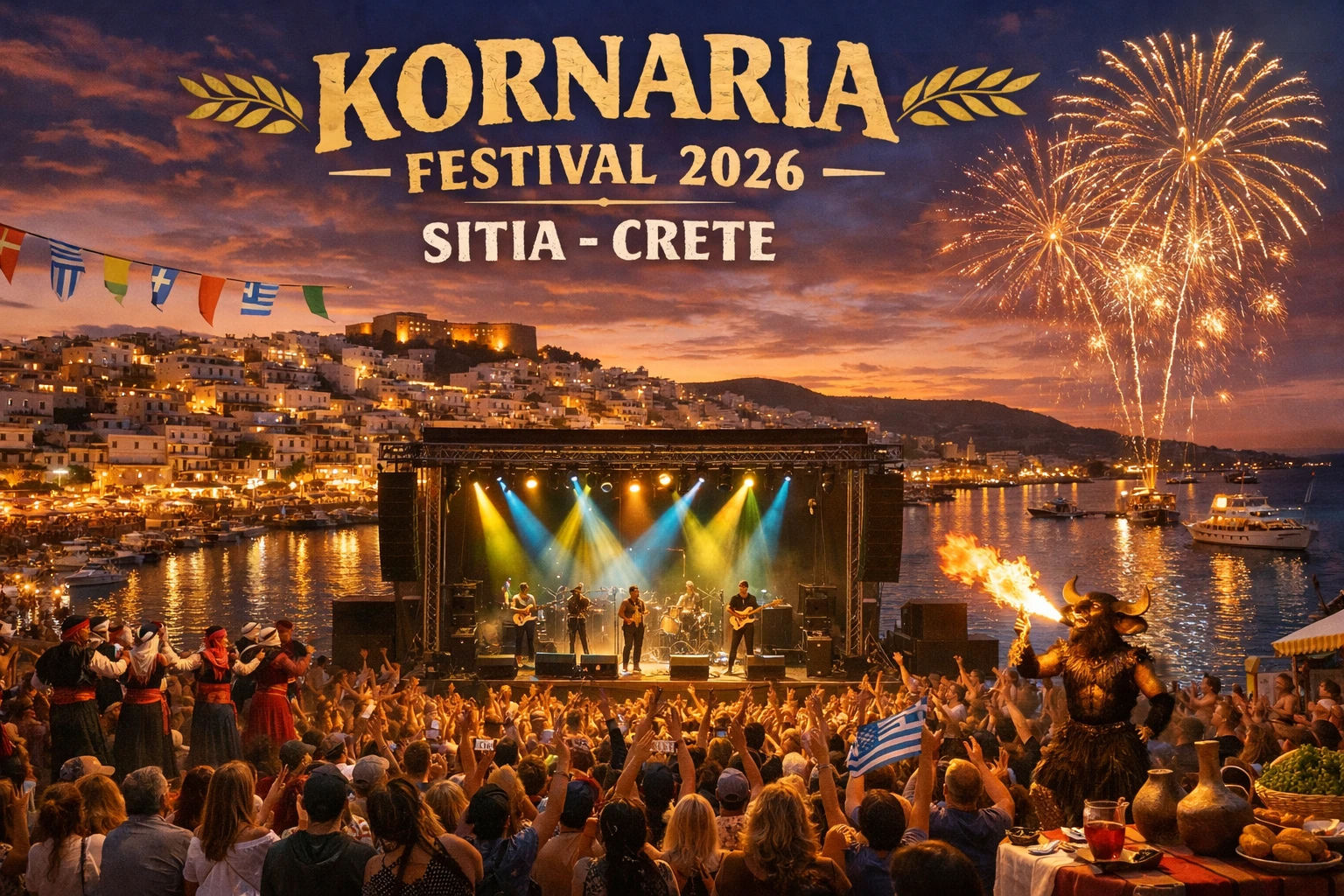
    Kornaria Festival 2026 – Sitia
    Cultural / Music / Folk
    Free

    Kornaria Festival 2026 – Sitia

    Kornaria Festival 2026 – Sitia, Crete: the Eastern Island's Greatest Summer Cultural Celebration

    At the far eastern edge of Crete, where the island narrows to its most rugged and unhurried self, the city of Sitia has been celebrating its greatest poet every summer since 1984. The festival is called Kornaria (Κορνάρεια), and it runs from early July through mid-August 2026 across the restored walls of a Venetian fortress, in village squares that fill with music and the smell of raki, along a harbor promenade where the summer evening lasts until the stars come out over the Libyan Sea.

    It is not the most famous festival in Crete. The crowds who pack Heraklion for its summer arts season or fill the garden theatres of Chania often drive straight past Sitia on their way to the beach resorts further east. That, as anyone who has attended Kornaria will tell you, is entirely their loss. For over 40 years, the Municipality of Sitia has been quietly running one of the richest and most culturally specific summer festivals in the eastern Mediterranean, and 2026 marks another edition of this genuinely irreplaceable Cretan celebration.


    The man behind the name: Vitsentzos Kornaros and the Erotokritos

    The Kornaria Festival does not take its name from a place or a political institution. It takes its name from a person: Vitsentzos Kornaros (also written Vincenzo Cornaro), the 17th-century Cretan poet who was born in the Sitia region and who gave the Greek world its most beloved epic poem.

    The Erotokritos is a romantic verse narrative of extraordinary length and beauty, running to approximately 10,000 lines of fifteen-syllable rhyming verse in the Cretan Greek dialect. Written between 1600 and 1650 (scholars debate the precise dates), the poem tells the story of Erotokritos, a young man of modest birth, and Aretousa, the daughter of the King of Athens, whose love for each other must survive separation, exile, and war before it can be fulfilled. The poem draws on ancient Greek, Byzantine, and Italian Renaissance literary sources and weaves them into something that is completely and distinctly Cretan in its emotional register and its language.

    The Erotokritos was not merely read. It was sung. In the tradition of oral Cretan culture, the poem was transmitted through musical performance, and the practice of singing Erotokritos verses to the accompaniment of the Cretan lyra has never died out. Today, any Cretan who has grown up in a traditional family will know verses by heart, and at any proper Cretan panegyri (village festival), passages from the Erotokritos are still sung in the same modal musical style that has been used for four centuries. Kornaria, then, is not simply a cultural program with a poet's name attached to it. It is a festival that honors the living inheritance of the greatest work of Cretan literature, and every concert, every theatrical performance, every village panegyri held under its umbrella is a continuation of that inheritance.


    The history of Kornaria: 40+ years of cultural dedication in eastern Crete

    The Kornaria Festival was established in 1984 by the Municipality of Sitia, with the explicit purpose of honoring Vitsentzos Kornaros and promoting the cultural development of Sitia and the broader eastern Crete region. The founding vision was stated clearly in the organizing documents: to encourage the cultural life of Sitia's community and to give foreign visitors a direct experience of the customs and traditions of eastern Crete.

    More than four decades later, both objectives remain firmly in the program. Kornaria has grown from a modest municipal program into what Tovima, one of Greece's most respected news organizations, describes as part of a broader "cultural revival" in Sitia that is "driving tourists to Crete's Sitia," with the municipality's cultural programming recognized as a significant factor in attracting visitors who might otherwise pass through eastern Crete without stopping.

    The 2025 edition, like those before it, covered a period stretching from late June through the August high season, with dozens of events spread across the city of Sitia and the villages of the wider municipality. The 2026 edition follows the same established annual framework, with the full program to be announced by the Municipality of Sitia in the weeks preceding July.


    The primary venues: Kazarma Fortress and the Polykentro

    The Venetian Fortress Kazarma: a stage 500 years in the making

    The center of the Kornaria Festival's evening program is the Venetian Fortress Kazarma (Ενετικό Φρούριο Καζάρμα), one of the most atmospheric open-air performance venues in all of Crete.

    Kazarma (the name derives from the Italian casa di arma, meaning house of arms) was built by the Venetians on the elevated ground above Sitia's harbor, and the current restored structure represents the final chapter of a series of fortifications that have occupied this site since the Byzantine period. An earthquake in 1508 devastated Sitia so severely that the Venetians briefly considered abandoning the city entirely; the fortress was eventually rebuilt and served throughout the later Venetian period as the city's primary military installation before falling into Ottoman hands in 1651.

    Today, the fully restored fortress hosts the Kornaria Festival's main concerts, theatrical productions, and dance performances from an outdoor stage set within the walls. The view from the fortress across Sitia's harbor and the Gulf of Sitia to the open sea is described by TheNewCrete as "impressive, especially at night," and it is hard to argue with that assessment: watching a performance of Cretan music or a theatrical production at Kazarma in July, with the fortress walls lit and the harbor lights reflecting on the water below, is the kind of experience that keeps visitors returning to eastern Crete year after year.


    The Polykentro: indoor culture at the heart of the city

    The Polykentro (Πολύκεντρο), the Municipality of Sitia's multi-purpose cultural center in the city center, serves as the indoor complement to the Kazarma's open-air program. The Polykentro hosts art and photography exhibitions, theatrical productions that require an indoor setting, lectures, educational events, and the more intimate musical performances that the open fortress stage cannot accommodate.

    Together, Kazarma and the Polykentro give Kornaria a two-venue structure that allows the festival to program simultaneously at different scales and for different audiences, running an outdoor concert at the fortress and an art exhibition or lecture at the Polykentro on the same evening.


    What Kornaria includes: the full program framework

    The Kornaria Festival is one of the most programmatically diverse cultural events in eastern Crete, covering nearly every form of live cultural expression. Based on the confirmed annual framework, the 2026 edition will include:

    Music and dance concerts

    Live concerts at the Kazarma Fortress form the heart of the evening program throughout July and into August. The program typically spans:

    • Cretan traditional music: lyra, laouto, and Cretan song, performed by some of the finest musicians from the Sitia region and eastern Crete
    • Greek popular music (laïká): the genre that has defined mainstream Greek musical culture since the mid-20th century
    • Contemporary Greek music: singer-songwriters, rock, and fusion acts who bring the festival's musical range into the present
    • Traditional dance performances: regional dance groups performing the distinctive footwork and costumes of eastern Cretan dance traditions

    Theatre and performing arts

    Theatrical productions, including translations of classical works and contemporary Greek plays, are staged at Kazarma and the Polykentro throughout the summer season. Recent editions have included productions by professional Greek companies, youth theatre groups, and community theatre organisations from within the Sitia municipality.

    Art and photography exhibitions

    The Polykentro hosts rotating exhibitions of fine art and photography throughout the festival period, presenting both established Greek artists and emerging local talent from the eastern Crete region. The arts program gives Kornaria a visual dimension that many music-focused festivals lack, and the exhibitions are open to all visitors free of charge.

    Lectures and educational events

    In keeping with the festival's founding mission of honoring Vitsentzos Kornaros and the literary heritage of eastern Crete, the Kornaria program includes lectures, symposia, and educational presentations on Cretan history, literature, language, and culture. These events draw academics, writers, and cultural figures from across Greece and are often conducted in a public forum format open to all attendees.

    Sports events: the Kornarios road race and beach volleyball

    The Kornaria Festival extends beyond the cultural arts into sport, organizing the "Kornarios" road race, a competitive athletics event that draws participants from across Greece, and a beach volleyball competition held on Sitia's beach. The combination of competitive sport and cultural programming gives Kornaria a breadth that few other island festivals in Greece can match.

    The village dimension: Kazanemata, Klidonas, and the panegyria

    One of the most distinctive aspects of Kornaria is the way it extends far beyond the city of Sitia into the villages of the wider municipality, giving the festival a geographic range that connects eastern Crete's urban and rural communities.

    Kazanemata: the raki feast

    Kazanemata (Καζανέματα) are the traditional communal raki-distillation feasts that take place in eastern Crete every autumn, when the grape-pressing season ends and the distillation of tsikoudia (Cretan spirit, similar to Italian grappa) fills the mountain villages with the smell of heated copper stills and the sound of lyra music. Within the Kornaria framework, Kazanemata events are organized in the villages of the Sitia municipality, allowing summer visitors to experience a tradition normally associated with the September to November harvest season at a time when the weather is reliably warm and Crete is fully accessible.

    The Tovima cultural report from 2024 describes how during these events visitors can learn about the "kazanema" tsikoudia distillation process, cheese-making practices, the use of local herbs, the legendary Cretan knives, the famous "stivania" boots, Cretan lyra making, and wooden shepherd's canes, representing a comprehensive immersion in the material culture of eastern Crete.

    Klidonas: the midsummer fire ritual

    Klidonas (Κλήδονας) is a traditional Greek midsummer festival associated with the feast of Saint John (June 24), in which young women place personal objects in water jars and immerse them overnight, then divine their romantic fortunes from the water the following morning. The tradition is accompanied by bonfires that young men and women jump over for luck, singing specific Klidonas songs, and communal celebration. Within the Kornaria framework, Klidonas events are organized in the villages of the Sitia municipality during the third week of June, just before the main festival opens in July.

    The village panegyria

    The village festivals (panegyria, singular: panegyri) organized under the Kornaria umbrella throughout July and August represent perhaps the most authentically Cretan component of the entire festival. Based on the confirmed 2025 Kornaria village program (published by CretaFocus in June 2025), the panegyria typically take place on religious saints' days across the villages of the Sitia municipality, with traditional Cretan bands performing from 9:00 pm or 9:30 pm onward.

    Confirmed ticket pricing for village panegyria events: €15, which includes a full traditional Cretan menu served communally at tables set up in the village square or school courtyard. This combination of traditional food, live Cretan music, communal seating, and the specific setting of a small eastern Cretan village on a warm summer evening is one of the most honest and irreplaceable cultural experiences that Crete offers any visitor.


    Sitia and eastern Crete: the wider destination

    Sitia itself

    Sitia (population approximately 9,000) is the administrative center of the Lasithi Prefecture's eastern section and one of the most relaxed and genuinely habitual cities on the island. Its harbor promenade, the long seafront lined with tavernas and cafes, is the social heart of city life throughout the summer, and the Sitia Archaeological Museum holds a collection of Minoan artifacts from the eastern Crete region that is second in Crete only to the Heraklion Archaeological Museum.

    The city is also known for producing some of the finest olive oil in the world: the PDO Sitia designation covers a specific variety of Cretan olive oil from the region's ancient terraced groves, and the annual olive harvest in October is itself an event that draws visitors.


    The wider eastern Crete landscape

    Within a 30 to 60-kilometer radius of Sitia, visitors attending Kornaria can access:

    • Vai Beach: the only natural palm forest in Europe, a beach bordered by thousands of wild date palms, approximately 25 kilometers northeast of Sitia
    • Kato Zakros: the site of a Minoan palace on the eastern coast, accessible by sea or through the spectacular Valley of the Dead gorge hike
    • Toplou Monastery: one of the most important and richly decorated monasteries in Crete, approximately 18 kilometers from Sitia, founded in the 14th century
    • Mochlos: a tiny fishing village and archaeological site on Sitia's coast, where Minoan tombs carved into the cliffsides overlook an offshore islet that was once connected to the mainland


    Practical information for Kornaria Festival 2026

    Getting to Sitia

    Sitia Airport (JSH) operates seasonal domestic flights from Athens during the summer months, making direct access to eastern Crete possible without driving the full length of the island. Alternatively, Heraklion International Airport (HER) is the main entry point, from which Sitia is approximately 2 hours 45 minutes by road via the Cretan north coast highway through Agios Nikolaos and Ierapetra.

    KTEL (intercity bus) services connect Heraklion to Sitia multiple times daily throughout the summer season, making car-free access to Kornaria entirely practical.


    Accommodation in Sitia

    Sitia offers accommodation ranging from small family-run hotels on the harbor promenade to self-catering apartments and villas in the hills above the city. July and August are peak season; booking 6 to 8 weeks in advance is strongly recommended, particularly for Kazarma concert evenings when demand increases.


    Ticket and event information

    • Village panegyria: €15 per person (includes full traditional meal and live Cretan music)
    • Main Kazarma concerts: specific 2026 pricing to be announced; many performances are free or at low cost consistent with the municipality's accessibility philosophy
    • Art exhibitions and lectures at the Polykentro: free to attend
    • Official information: Municipality of Sitia website (sitia.gr) and Visit Sitia (visitsitia.gr)


    Verified Information at a glance

    Event name: Kornaria Festival 2026 (Κορνάρεια 2026), Sitia, Crete

    Event category: Annual multi-arts summer cultural festival: music, theatre, dance, exhibitions, sports, village panegyria

    Confirmed dates: Early July to mid-August 2026 (pre-festival events including Klidonas from late June; full program to be announced by Municipality of Sitia)

    Founded: 1984 (the 2026 edition marks 42 years of continuous programming)

    Primary venues: Venetian Fortress Kazarma (outdoor) and Polykentro Municipal Cultural Centre (indoor), Sitia, Crete

    Village events: Kazanemata (raki feasts), Klidonas (late June), and village panegyria across Sitia municipality

    Named in honor of: Vitsentzos (Vincenzo) Kornaros, Cretan poet, author of the Erotokritos (c.1600 to 1650)

    Village panegyria ticket price: €15 per person (includes full traditional Cretan menu)

    Free events: Art exhibitions, photography shows, lectures at Polykentro; many outdoor performances

    Sports events: "Kornarios" road race (pan-Hellenic participants); beach volleyball competition

    Organizer: Municipality of Sitia

    Official websites: visitsitia.gr / sitia.gr

    Nearest airports: Sitia Airport (JSH) (seasonal); Heraklion International Airport (HER) (approx. 2h45m by road)


    When the lyra player takes the stage at Kazarma as the summer night settles over the Gulf of Sitia and the fortress walls glow in the warm light, and the music that comes out is the same music that Vitsentzos Kornaros heard in these eastern Cretan hills four hundred years ago before he sat down

    Sitia, East Crete, Crete
    Jul 4, 2026 - Aug 15, 2026
    Chania Summer Festival 2026
    Cultural Festival / Performing Arts
    TBA

    Chania Summer Festival 2026

    Chania Summer Festival 2026: Crete's Most Beautiful City Turns Into a Stage

    There is a moment, usually sometime in the second week of July, when the city of Chania on the northwest coast of Crete shifts into a mode that the rest of the year simply cannot replicate. The lights come on inside the Firka Fortress as dusk settles over the Venetian harbour. The scent of the sea mixes with the smell of food from the old town's restaurants. And from somewhere beyond the crowd gathering at the water's edge, music begins.

    This is the Chania Summer Festival, Crete's most enduring and wide-ranging annual cultural event, running every year from July through September across the historic venues and open-air spaces of one of the most visually stunning cities in all of Greece. In 2026, the festival once again fills Chania's summer months with theatre, classical music, jazz, dance, rock, art exhibitions, and traditional Cretan performance, drawing visitors and locals alike into the cultural life of a city whose history alone could fill a semester of study.


    What exactly is the Chania Summer Festival?

    The Chania Summer Festival (also known as the Municipal Cultural Summer Festival) is not a single ticketed event with a start date and an end date. It is better understood as a season-long cultural activation of the city, organized annually by the Municipality of Chania in collaboration with the ΚΕΠΠΕΔΗΧ-ΚΑΜ (the municipal cultural and youth organization).

    From July to the end of September each year, the festival presents a rotating program of:

    • Classical music concerts featuring Cretan and Greek ensembles as well as international visiting performers
    • Theatrical productions in Greek and translated works, performed at outdoor venues across the old city
    • Traditional Cretan dance shows, where regional dance groups perform the complex footwork and musical traditions of Cretan culture that have been passed down for generations
    • Jazz performances at the harborfront and in the old city's intimate courtyards
    • Art exhibitions presenting both traditional Cretan artistic heritage and contemporary Greek visual art
    • Outdoor film screenings at the harborfront and in open-air theater spaces across the city

    The festival's programming philosophy is deliberately inclusive, offering events that range from free public performances at open-air squares to ticketed concerts at the city's major cultural venues. Some performances require tickets, while many of the street and harbor events are entirely free to attend.


    The venues: Chania's history becomes the festival's stage

    One of the defining features of the Chania Summer Festival is where it happens. The organizers do not build festival infrastructure and bring it down again. They use the city itself as the venue, and the city happens to contain some of the most atmospherically extraordinary performance spaces in the eastern Mediterranean.


    The Firka Fortress

    The Firka Fortress (Φρούριο Φιρκά) at the entrance to Chania's Venetian harbour is the festival's most iconic venue. Built by the Venetian Republic in 1538 under the engineer Michele Sanmichele (who also designed Heraklion's defenses), the fortress sits on the harbour's edge, facing the open sea. Its battlements and open interior create an open-air theater with a view of the sea that no purpose-built concert venue can offer. Concerts of Greek music, theatrical productions, and dance performances all take place within Firka's walls throughout the summer season.


    The Venetian Harbour promenade

    The Venetian Harbour, with its crescent of stone buildings, the 1570 Venetian Lighthouse standing at the end of the mole, and the small boats and traditional kaïkia tied along the quay, serves as the festival's extended public living room throughout the summer. Free concerts, street performances, and cultural gatherings happen along the harbourfront promenade regularly, creating the sense that the festival is not a scheduled cultural event but simply the natural state of Chania in July and August.


    The East Moat Theatre (Theatro Anatolikis Tafrou)

    The East Moat Theatre (Θέατρο Ανατολικής Τάφρου), built into the historic defensive fortifications of the old city, is Chania's main outdoor amphitheater and the venue for the city's largest summer concerts. It is here, at the East Moat Theatre, that the Chania Rock Festival 2026 will take place, as it has for the past several years, establishing this Venetian-era space as one of Greece's most distinctive and internationally recognized rock concert venues.


    The harborfront and old town courtyards

    Beyond the main venues, the festival animates the narrow lanes and Byzantine-period courtyards of Chania's Old Town, placing smaller theatrical and musical events in settings that are centuries older than the festival itself. Walking through the old city during the summer season in Chania means regularly encountering an unexpected performance in a doorway, a plaza, or a church courtyard, and that quality of accidental cultural encounter is one of the things that makes Chania's summer different from any other city's festival season.


    Chania Rock Festival 2026: the festival's metal and rock flagship event

    Within the broader summer cultural program, the Chania Rock Festival 2026 stands out as the single most precisely confirmed large-scale event, with a full confirmed lineup and ticketing details already publicly available.

    The Chania Rock Festival is confirmed for Saturday, August 1 and Sunday, August 2, 2026, at the Theatro Anatolikis Tafrou (East Moat Theatre), Chania, Crete.


    Confirmed 2026 lineup

    Day 1, Saturday August 1:

    • STRATOVARIUS (Finland): one of the defining bands of European power metal, active since 1984
    • GEOFF TATE (USA): founding vocalist of Queensrÿche, with a 40-year career in progressive metal
    • ELYSION (Greece): Gothic and symphonic metal
    • DEVISER (Greece): black and death metal
    • BLACK SUN (Greece): Greek rock and metal

    Day 2, Sunday August 2:

    • KREATOR (Germany): one of the founding bands of German thrash metal, globally recognized with over 35 years of recording history
    • ROTTING CHRIST (Greece): Athens-based black metal institution and arguably the most internationally recognized Greek metal band in history
    • LECKS INC. (France): French metal
    • MADVICE (Italy): Italian metal
    • FLAMECORE (Greece): Greek metal

    The presence of Kreator and Rotting Christ on Day 2 is worth specific attention: these are internationally touring headliners who regularly appear at the largest European metal festivals. The Therion Facebook page has noted the 2026 Chania Rock Festival as the "only Therion concert in Europe in 2026," reflecting the festival's drawing power for major international acts seeking an intimate and distinctive southern European setting.


    Chania Rock Festival 2026 ticket information

    Based on pricing confirmed from the festival's official ticketing page at chaniarockfestival.gr:

    • The 2025 two-day pass was €83, with single-day tickets at €45 each
    • The 2026 pricing is expected to follow a similar framework; check chaniarockfestival.gr for official 2026 prices
    • Tickets are available at points of sale including Posto di Cafe, Alikianou, and the Gkanakakis Market, as well as online through the festival's official website


    The broader cultural tapestry: what the Chania summer season offers

    The Chania Summer Festival exists within a broader cultural ecosystem in the Chania region that makes any summer visit to the city an especially rich experience.


    Jazz in July: Vamos and the Apokoronas Villages

    Approximately 20 kilometers east of Chania, in the Apokoronas district, the Jazz in July Festival takes place annually in the village of Vamos, bringing international and Greek jazz artists to one of Crete's most beautifully preserved traditional villages. This festival, which runs concurrently with the early weeks of the Chania Summer Festival, provides a quieter and more intimate alternative to the city's programming.


    Traditional Cretan music and lyra performances

    No account of Chania's summer cultural life is complete without acknowledging the centrality of Cretan traditional music to the city's identity. The Cretan lyra, a pear-shaped bowed instrument played upright on the knee, is the island's defining musical voice, and the dances and songs associated with it represent a living cultural tradition of significant antiquity. The Municipal Cultural Summer Festival programs traditional Cretan music and dance regularly throughout the July to September season, providing visitors with direct access to performances that are culturally specific to this particular island.


    The Samaria Gorge and Elafonissi: nature alongside culture

    The festival's summer timing coincides with the best conditions for exploring the natural environment that surrounds Chania. The Samaria Gorge, the longest gorge in Europe at 18 kilometers, opens for hiking from May through October and sits approximately 45 kilometers from Chania's center. The Elafonissi lagoon beach, approximately 75 kilometers southwest of Chania, with its distinctive pink-tinged sand caused by crushed shells mixed with white beach sand, is Crete's most photographed natural site. A summer visit that combines the cultural program of the Chania Summer Festival with a morning hike or a beach day at Elafonissi addresses virtually every category of Mediterranean travel motivation simultaneously.


    Practical guide to visiting Chania for the 2026 Summer Festival

    Getting to Chania, Crete

    Chania International Airport (Ioannis Daskalogiannis, CHQ) receives direct flights from Athens, Thessaloniki, and major European cities including London, Amsterdam, Paris, Berlin, Frankfurt, and Vienna throughout the summer. The airport is approximately 15 kilometers east of the city center.

    Crete is also accessible by overnight ferry from Piraeus (Athens), with the journey taking approximately 8 to 9 hours, arriving in Chania's port at Souda Bay, 7 kilometers east of the city.


    When to go for the festival

    • Early July: the Municipal Cultural Summer Festival begins; the city is busy but not at peak capacity; excellent conditions for exploring venues and attending the opening program
    • Late July: the season hits full stride; the festival program is at its most diverse, Jazz in July is running in Apokoronas; the city is at full summer vibrancy
    • August 1 to 2, 2026: the Chania Rock Festival at the East Moat Theatre; the single biggest confirmed ticketed event of the summer
    • August through September: the full breadth of the Municipal Cultural Summer Festival continues; the city remains active through September with theater, dance, and music events


    Where to stay

    Chania's Old Town offers accommodation within walking distance of all festival venues. The Venetian Harbour neighbourhood puts you closest to the Firka Fortress and harborfront events. Hotels frequently cited by cultural visitors include those in the converted Venetian buildings along and near Nikiforou Foka Street, the main road through the old harbor district. Book accommodation for the first week of August well in advance, as the Chania Rock Festival significantly increases demand for those two nights specifically.


    Practical tips

    • The Municipal Cultural Summer Festival runs from July to end of September 2026; the exact program for each week is published on the Municipality of Chania's website and on the ΚΕΠΠΕΔΗΧ-ΚΑΜ cultural organization's channels
    • Many events are free; check listings when you arrive or monitor the city's official social media for real-time program updates
    • The old city is best navigated on foot; comfortable shoes are essential as most venues are on cobblestones
    • Chania in August averages temperatures of 27 to 30°C with virtually no rainfall; carry water to outdoor evening events
    • The Agora (covered market) near the old city provides excellent local provisions including Cretan olive oil, thyme honey, and graviera cheese for self-catering between events


    Verified Information at a glance

    Item: Confirmed details

    • Event name: Chania Summer Festival 2026 (Municipal Cultural Summer Festival)
    • Event category: Annual municipal cultural festival: theatre, classical music, dance, jazz, art exhibitions, outdoor cinema
    • Confirmed dates: July through September 2026 (exact program published by Municipality of Chania)
    • Main venues: Firka Fortress, Venetian Harbour promenade, East Moat Theatre (Theatro Anatolikis Tafrou), Old Town courtyards
    • Admission: Mix of free (outdoor and harbor events) and ticketed (major concerts and productions)
    • Organizer: Municipality of Chania in collaboration with ΚΕΠΠΕΔΗΧ-ΚΑΜ

    Chania Rock Festival 2026

    • Date: Saturday August 1 and Sunday August 2, 2026, East Moat Theatre, Chania
    • Rock Festival Day 1 lineup: Stratovarius (FIN), Geoff Tate (USA), Elysion (GR), Deviser (GR), Black Sun (GR)
    • Rock Festival Day 2 lineup: Kreator (GER), Rotting Christ (GR), Lecks Inc. (FRA), Madvice (ITA), Flamecore (GR)
    • Rock Festival tickets: 2025 pricing: 2-day pass €83; single day €45; 2026 pricing: check chaniarockfestival.gr

    Nearest airport: Chania International Airport (CHQ), approx. 15 km from city center

    Official Rock Festival website: chaniarockfestival.gr

    Official tourism info: chaniatourism.gr

    Between the harborfront promenades of July, the theatrical evenings at the Firka Fortress throughout August, the traditional Cretan dance shows that bring the island's living folk heritage to outdoor stages, and the roar of Kreator and Stratovarius filling the East Moat Theatre on the first weekend of August, the Chania Summer Festival 2026 offers a cultural program that runs the full spectrum from ancient to contemporary and from Greek-specific to internationally universal. There is genuinely no other city of Chania's size anywhere in Greece that packs this combination of history, natural beauty, and live cultural programming into a single summer season, and 2026 is the year to experience it firsthand.

    , Crete
    Jul 6, 2026 - Aug 2, 2026
    Rethymno Renaissance Festival 2026
    Cultural Festival / Arts
    TBA

    Rethymno Renaissance Festival 2026

    The Rethymno Renaissance Festival 2026 is one of Crete’s most atmospheric summer events, turning the old Venetian heart of Rethymno into a living stage of music, theatre, dance, and visual art. Confirmed listings show the festival running from Wednesday, 15 July 2026, until Thursday, 20 August 2026, with events starting around 20:30 in the Old Town, Rethymno.

    This is the kind of festival that feels made for island travelers, blending Cretan heritage, seaside evenings, and the timeless beauty of a town built between the mountains and the sea.

    "The festival gives you a reason to slow down, stay out late, and experience the city through its sounds, tastes, and historic spaces."

    The Story of the Rethymno Renaissance Festival

    Crete's Cultural Jewel

    Rethymno’s Renaissance Festival is not just a summer entertainment program; it is part of the town’s cultural identity. The municipality says the festival has been supported for more than 20 years, and each summer it brings together hundreds of artists from around the world for theatre, music, dance, and exhibitions.

    "Visitors are not only attending a performance, they are stepping into a cultural story shaped by Rethymno’s Venetian past, its old town lanes, and the city’s strong artistic spirit."

    The 2026 Experience

    Dates and Setting

    The 2026 edition is listed for 15 July 2026 to 20 August 2026, placing it squarely in the heart of the Cretan summer. Events are scheduled in the Old Town of Rethymno, a setting that adds a beautiful layer of atmosphere to every concert, play, or exhibition.

    Rethymno’s old town is one of the best-preserved historic districts in Crete, full of Venetian architecture, narrow lanes, courtyards, and stone buildings that suit open-air culture perfectly. The festival also has a strong association with major historic venues in the city, especially the Fortezza Fortress.

    A Festival Rooted in Heritage

    Celebrating the Venetian Past

    The Renaissance Festival in Rethymno was created to celebrate the city’s Venetian and broader Renaissance heritage. Instead of focusing only on modern entertainment, it celebrates the artistic memory of the city through period-inspired performances, classical music, theatre, and art presentations.

    Rethymno itself helps tell that story. The town sits on Crete’s north coast between Chania and Heraklion, known for its Venetian port, historic mosques and churches, and the imposing Fortezza rising above the city.

    What Visitors Can Expect

    A Blend of Culture and Atmosphere

    The Rethymno Renaissance Festival 2026 is likely to include a broad mix of cultural events based on past editions and current listings. Visitors can expect:

    • Theatre performances.
    • Renaissance and classical music concerts.
    • Dance shows.
    • Art exhibitions.
    • Costumed and historical performances.
    • Open-air cultural nights in the old town and fortress areas.

    The experience is especially strong in the evening, when the temperature softens and Rethymno’s historic streets begin to glow under warm light.

    A Night Out in Old Town Rethymno

    Blending with the City

    One of the biggest charms of the Rethymno Renaissance Festival 2026 Crete is how naturally it blends with the old town itself. The narrow streets, balconies, stone arches, and hidden courtyards create a setting where even a simple walk between venues feels part of the performance.

    Rethymno’s old town is compact and pleasant to explore on foot, making it easy for visitors to move from a performance to dinner or a seaside walk afterward.

    Fortezza and Other Cultural Spaces

    Historic Venues as Dramatic Stages

    The Fortezza Fortress is one of the most important backdrops connected to the Renaissance Festival. Built in the Venetian era, it gives the event a dramatic stage and helps explain why the festival has such a strong identity in Rethymno.

    Other cultural spaces in the city are also used for festival programming, including venues in the old town and heritage buildings linked to music, theatre, and art.

    Why Crete is the Right Backdrop

    A Perfect Island for Cultural Exploration

    Crete is one of the best islands in Greece for a festival like this because it already has a strong sense of place. The island blends ancient history, Venetian influence, mountain landscapes, seaside towns, and a lively cultural calendar.

    Rethymno sits right in the middle of that mix, offering visitors the chance to enjoy beaches, harbor walks, local tavernas, and village trips inland.

    Food, Evenings, and Local Atmosphere

    Cretan Flavors and Summer Nights

    A visit to the festival is even better when paired with the local food and evening culture of Crete. In Rethymno, you can spend the afternoon by the beach, then head into the old town for a performance and stay out for dinner afterward.

    Expect plenty of Cretan flavors nearby, including olive oil dishes, fresh seafood, dakos, grilled meats, and local wines.

    Ticket Information and Pricing

    Accessing the Festival

    Confirmed listings say that many open-air concerts, theatre performances, and street shows are free and open to the public, while some special performances may require tickets.

    Published pricing from related festival listings suggests that ticketed events are often in the range of €10 to €30, depending on the performance and seating type.

    Getting There and Staying Nearby

    Making the Most of Your Visit

    Rethymno is located on Crete’s north coast, about halfway between Chania and Heraklion. That makes it relatively easy to reach by road from either major city.

    Good places to stay include:

    • Rethymno Old Town, for the most atmospheric experience.
    • The beachfront area, for easy access to sea and evening walks.
    • Nearby neighborhoods close to the Venetian harbor, for a balance of convenience and character.

    If you are visiting in July or August, booking ahead is wise because this is peak season on Crete.

    Practical Tips for Visitors

    Enhancing Your Festival Experience

    A few simple tips can make the festival smoother and more enjoyable:

    • Arrive early for evening events, especially if they are in smaller historic venues.
    • Wear comfortable walking shoes, since old town streets can be uneven.
    • Bring light clothing for warm summer nights, but keep a thin layer for coastal breezes.
    • Check the city and festival pages regularly for performance updates and venue changes.
    • Plan a full evening, because the festival atmosphere is part of the experience, not just the performance itself.

    If you are combining the festival with sightseeing, leave time for the Venetian harbor, Fortezza, and a slow wander through the old town before the show begins.

    Nearby Sights Worth Adding

    Complementing Your Festival Visit

    The festival pairs nicely with a few of Rethymno’s most loved landmarks:

    • Fortezza Fortress, the city’s signature historic structure.
    • The Venetian Old Town, with its narrow streets and heritage buildings.
    • The harbor area, ideal for a relaxed pre-show walk.
    • Local museums and cultural spaces that deepen the city’s historical story.

    Visitors who love culture will find that the festival is only one part of what makes Rethymno feel special. It is the whole city that creates the experience.

    Verified Information at a Glance

    • Event Name: Rethymno Renaissance Festival 2026.
    • Category: Cultural festival, theatre, music, dance, and art.
    • Dates: 15 July 2026 to 20 August 2026.
    • Time: Around 20:30 for listed events.
    • Venue: Old Town, Rethymno, Crete.
    • Associated Landmark Venue: Fortezza Fortress.
    • Organizer: Municipality of Rethymno.
    • History: Supported by the municipality for more than 20 years.
    • Typical Ticket Pricing: Some events free, ticketed performances generally around €10 to €30 where applicable.

    The Rethymno Renaissance Festival 2026 Crete is one of those rare events that feels both elegant and deeply local, and it offers travelers a beautiful reason to spend warm summer nights in one of Crete’s most enchanting towns. If you are planning a trip to the island in July or August, this is a festival worth building your journey around, because Rethymno knows how to turn history, music, and summer nights into something unforgettable.

    Old Town & Fortezza, Rethymno, Crete, Greece, Crete
    Jul 15, 2026 - Aug 20, 2026
    Panagia Kera Festival 2026
    Religious Festival / Village Feast
    Free

    Panagia Kera Festival 2026

    There are festivals that entertain, and there are festivals that reach into something far older and far deeper. The Panagia Kera Festival in Crete belongs irrefutably to the second category. Celebrated across multiple sacred sites on the island each year, with the principal dates falling on August 14 to 15, 2026 (the Dormition of the Virgin, known as Dekapentavgoustos) and September 7 to 8, 2026 (the Nativity of the Virgin), this is one of the most spiritually charged and culturally vivid celebrations in the entire Greek Orthodox calendar. On these days, some of Crete's most ancient and breathtaking religious sites come fully alive with liturgy, candlelight vigils, traditional Cretan music, communal feasting, and the warm, open-hearted hospitality for which this island is genuinely famous.

    For travelers who want to experience Crete at its most authentically and deeply Cretan, planning a visit around either the August 15 or September 8, 2026 celebrations at the island's Panagia Kera churches and monasteries is one of the most rewarding decisions you can make. These are not staged performances for tourists. They are living expressions of a faith and a cultural identity that has survived Byzantine empire, Venetian rule, Ottoman occupation, and the modern world with its roots entirely intact.

    "Panagia" is the Greek word for the Holy Virgin, meaning "All Holy," and she is venerated with an intensity in Crete that goes beyond even the usual devotion of the Greek Orthodox tradition.

    What Is the Panagia Kera Festival?

    The Virgin Mary at the Heart of Cretan Life

    The island has more churches dedicated to the Virgin than to any other saint, and her feast days are treated as community events of the highest order, drawing not just churchgoers but entire villages together in a celebration that weaves liturgy, music, dance, and food into a single flowing experience.

    The term "Panagia Kera" is used specifically to refer to several distinct and historically significant sacred sites on the island, most prominently:

    • The Church of Panagia Kera in Kritsa (near Agios Nikolaos in eastern Crete, Lasithi region): A small triple-aisled Byzantine church housing what are considered the finest preserved Byzantine frescoes in all of Crete. The oldest frescoes in the central nave date to the 13th century and depict scenes from the life of Christ, including the Ascension, the Last Supper, and the four Gospel scenes. The church sits approximately 1 kilometer south of the village of Kritsa, on the main road toward the ancient Minoan site of Lato.
    • The Monastery of Panagia Kera Kardiotissa (on the road connecting Pediada province and the Lasithi Plateau): An active nunnery with roots dating to at least 1333, when it appears in a document as a fief of the Latin Patriarchate of Constantinople. Dedicated to the Nativity of the Virgin, its main festival day is September 8.
    • The Church of Panagia Kera in Amari (near the village of Nefs Amari, Amari Valley, Rethymno region): A magnificent three-aisled basilica from the 15th century, built on the ruins of a 13th-century Byzantine church with a dome, which itself replaced an earlier structure believed to have been a temple dedicated to Apollo. The accumulated history beneath this single building spans more than two millennia.

    The August 14 to 15, 2026 Celebrations: Dekapentavgoustos

    Greece's "Little Easter" on Crete

    August 15 is, across the whole of Greece, a day of enormous spiritual and cultural weight. Known as Dekapentavgoustos (the Fifteenth of August) or the Feast of the Dormition (Assumption) of the Virgin, it is a national public holiday and the single most widely celebrated religious occasion on the Greek Orthodox calendar after Easter. On Crete in particular, where devotion to the Panagia runs especially deep, the entire month of August is informally known as "the month of the Panagia," and festivals and panigiria (village celebrations) related to her fill the calendar from the first day to the last.

    The celebrations follow the established Orthodox structure:

    • August 14 (Eve): Evening vespers and the beginning of vigil services at participating churches and monasteries across the island
    • August 15 (Main Day): Divine Liturgy celebrated in the morning, followed by a procession of the icon, communal gathering, traditional Cretan music performed on the lyra and laouto, dancing in the village squares, and communal feasting on local specialties
    The atmosphere across Crete on August 15 is unlike any other day of the year.

    The September 7 to 8, 2026 Celebrations: Nativity of the Virgin

    The Primary Festival Day at Panagia Kera Monasteries

    If the August 15 celebrations represent the grand communal spectacle of Panagia veneration on Crete, the September 7 to 8 festival cycle at the Panagia Kera sites carries a more intimate and profoundly devotional character that many visitors find even more moving.

    For the neighboring Panagia Charakiani Festival near Bali in Rethymno, which follows the same September 8 date pattern, the celebrations unfold at a church built directly into a rock face within a small gorge, one of the most unusual and dramatic religious settings in the entire Greek world. The icon there is also considered miraculous, and its pilgrims overlap significantly with those visiting the various Panagia Kera sites across Crete on the same date.

    The Music and Dance That Define the Festival

    Cretan Lyra, Laouto, and the Living Tradition

    Any visit to a Panagia Kera Festival celebration in 2026 will, almost inevitably, lead you to music. Cretan music is one of the most distinctive and emotionally powerful folk traditions in Europe, built around the lyra, a three-stringed bowed instrument played resting on the knee, and the laouto, a long-necked lute that provides rhythmic and harmonic accompaniment.

    For visitors, participation is not only welcomed but expected. A Cretan village panigiri has no audience. Everyone is a participant, and the long communal table, the carafe of raki, and the invitation to join the dance circle will arrive before you have finished your first plate of lamb.

    The Cultural Depth of the Panagia Kera Sites

    Byzantine Art and Architecture That Survived Everything

    Visiting the Church of Panagia Kera in Kritsa as part of the festival experience adds an art historical dimension that is extraordinary even by the standards of a Greece rich in Byzantine heritage. The frescoes inside this small triple-aisled church are the finest of their kind in Crete, painted across three successive periods from the 13th to the 14th century and representing three distinct Byzantine artistic schools.

    Entry to the church costs 2 euros, one of the most under-valued heritage experiences available anywhere in the Mediterranean. Visitors to the August 15 and September 8 celebrations should be aware that the church may be crowded during liturgical services and that respectful behavior, including modest dress with shoulders and knees covered, is expected and required.

    Practical Travel Tips for the 2026 Celebrations

    Planning Your Visit Around August 15 or September 8

    Whether you choose the August 14 to 15 or September 7 to 8, 2026 celebrations, several practical considerations will significantly shape your experience:

    • Book accommodation well in advance: Both festival dates are among the busiest of the Cretan year. Agios Nikolaos, the nearest town to the Kritsa church, fills up completely around August 15. Similarly, accommodation near the Lasithi Plateau and around Rethymno needs advance booking for the September 8 weekend
    • Arrive by car: Public transport in rural Crete is limited. Renting a car gives you the freedom to reach both the main Panagia Kera sites and the village panigiria that continue into the evening across the surrounding communities
    • Arrive at the church early on the festival morning: The liturgy at major Panagia Kera sites begins at sunrise or shortly after. Arriving early allows you to experience the full arc of the service and secure a position inside the church
    • Dress modestly: This is a sincere religious celebration. Women should cover their shoulders and wear skirts or trousers that cover the knee. Men should wear long trousers. Most churches provide coverings at the entrance for those who arrive unprepared
    • Stay for the panigiri: The communal feast and music that follows the morning liturgy is the cultural heart of the event and is completely open to visitors. Bring appetite and willingness to accept hospitality that will be pressed on you with genuine warmth
    • Visit the Lato archaeological site near Kritsa: If you are visiting the Kritsa Panagia Kera church, the ancient Dorian city of Lato just above the village is one of the finest and least-visited archaeological sites in Crete, offering extraordinary views across the Gulf of Mirabello

    The Broader Agios Nikolaos and Lasithi Experience

    Exploring Eastern Crete's Rich Offerings

    Eastern Crete around Agios Nikolaos is one of the island's most rewarding regions for independent travelers. The town's famous lake, the Gulf of Mirabello, the Minoan palace site of Malia to the west, the extraordinary Lasithi Plateau just above, and the dramatic gorge of Kritsa itself all provide multiple days of exploration that the Panagia Kera festival celebrations can anchor beautifully.

    Crete's cuisine in this region, built around local olive oil, fresh cheese, wild herbs, slow-cooked lamb, freshly caught fish, and the extraordinarily good local wines from the Sitia and Peza regions, will reinforce at every meal the sense that this island does everything with an instinctive and unhurried excellence.

    A Festival That Belongs to the Island and Welcomes the World

    The Enduring Bond Between Crete and the Panagia

    The Panagia Kera Festival in Crete in 2026 is not something organized for visitors. It happens because it has always happened, because the communities of this island have gathered at these sacred sites on these exact dates for centuries, and because the bond between the people of Crete and their Panagia is one of the deepest and most enduring relationships in the cultural life of the Mediterranean.

    What makes it remarkable for travelers is precisely that it is so genuine. When you stand in the courtyard of the Kritsa church on the evening of August 14, watching candles being lit one from another as the vespers begin, or when you find yourself drawn to the dance circle at a village square on the night of September 8, you are not experiencing a re-enactment. You are part of a living tradition that has survived eight centuries of history and shows no sign of diminishing.

    Come for the frescoes. Stay for the music. Leave with the kind of memory that only authentic island culture can produce.

    Frequently Asked Questions

    The Things People Always Want to Know

    Q1: When is the Panagia Kera Festival in Crete in 2026?

    The Panagia Kera celebrations in Crete take place on two primary dates: August 14 to 15, 2026 (the Feast of the Dormition of the Virgin, Dekapentavgoustos) and September 7 to 8, 2026 (the Nativity of the Virgin). The September 8 date is the main consecration celebration at the Church of Panagia Kera in Kritsa and the Monastery of Panagia Kera Kardiotissa.

    Q2: Where is the Panagia Kera church in Crete?

    The most famous Panagia Kera church is located approximately 1 kilometer south of the village of Kritsa, near Agios Nikolaos in eastern Crete (Lasithi region). A second Panagia Kera church is in the Amari Valley near Nefs Amari in the Rethymno region, and the Monastery of Panagia Kera Kardiotissa sits on the road connecting Pediada province and the Lasithi Plateau.

    Q3: How much does it cost to visit the Church of Panagia Kera in Kritsa?

    Entry to the Church of Panagia Kera in Kritsa costs 2 euros per person. The church is open to the public as a heritage site on regular days and as a place of active worship during festival celebrations.

    Q4: What happens at the Panagia Kera Festival celebrations in Crete?

    The celebrations follow Orthodox tradition: an evening vespers and vigil on the eve (August 14 or September 7), followed by Divine Liturgy on the main day (August 15 or September 8). After the church service, a panigiri (communal festival) takes place with traditional Cretan music performed on the lyra and laouto, dancing, and communal feasting. The celebration is open to all visitors.

    Q5: What are the best places to stay near the Panagia Kera church in Kritsa for the 2026 festival?

    Agios Nikolaos is the most convenient base, located approximately 10 km from the Kritsa church. The town offers a wide range of accommodation from budget guesthouses to four-star hotels. Elounda and Neapoli are also good alternatives within easy driving distance. Book well in advance for both the August 15 and September 8 festival weekends, as accommodation fills up rapidly.

    Verified Information at a Glance

    • Event Name: Panagia Kera Festival Crete 2026
    • Event Category: Religious and Cultural Festival / Panigiri / Greek Orthodox Celebration
    • Primary Celebration Dates: August 14 to 15, 2026 (Dormition of the Virgin); September 7 to 8, 2026 (Nativity of the Virgin)
    • Main Sites:
    • Church of Panagia Kera, Kritsa, near Agios Nikolaos, Lasithi, eastern Crete
    • Monastery of Panagia Kera Kardiotissa, Pediada/Lasithi Plateau road, central Crete
    • Church of Panagia Kera, Amari Valley, near Nefs Amari, Rethymno region
    • Entry Fee (Kritsa Church): 2 euros
    • Church Date of Origin (Kritsa): Original frescoes 13th century; church rebuilt 13th to 14th century
    • Monastery Origin (Kardiotissa): References from 1333; believed 12th-century roots
    • Nearest Town (Kritsa church): Agios Nikolaos (approximately 10 km)
    • Nearest Airport: Heraklion International Airport (HER); also Sitia Regional Airport for eastern Crete
    • Festival Character: Religious liturgy, icon procession, traditional Cretan music (lyra and laouto), Cretan dancing, communal feasting
    • Dress Code: Modest attire required; shoulders and knees covered
    • Admission to Festival Celebrations: Free (entry to the Kritsa church as heritage site: 2 euros)

    ```

    Eastern Crete villages, Greece, Crete
    Aug 14, 2026 - Sep 18, 2026
    Assumption Day (Dormition of the Virgin Mary) 2026
    Public Holiday / Religious
    Free

    Assumption Day (Dormition of the Virgin Mary) 2026

    On 15 August every year, including 15 August 2026, Crete slows down and turns its heart toward the church, family, and feast in honor of Assumption Day, also known as the Dormition of the Virgin Mary. Across villages and monasteries, the island becomes a patchwork of small religious services, processions, folk music, and open-air celebrations that blend the sacred with the deeply local.

    For island travelers, this is one of the richest cultural windows in the Greek summer calendar, a chance to experience Crete at its most traditional while still enjoying warm August evenings by the sea.

    "Crete's Assumption Day is not just a feast, it's a heartfelt celebration of tradition and community."

    What Assumption Day Means on Crete

    The “Easter of the Summer”

    In the Greek Orthodox calendar, 15 August is the Feast of the Dormition of the Theotokos, marking the “falling asleep” and assumption of the Virgin Mary into heaven, which is why the day is also widely referred to as Assumption Day. On Crete, this is not just a quiet church holiday; it is treated as one of the most important religious feasts of the year, often called the “Easter of the summer” because of the scale of celebration across towns and villages.

    That religious meaning is felt most strongly in the morning, when churches across the island hold Divine Liturgy and Matins for the Virgin Mary, often followed by the procession of her icon through the streets.

    Key Dates and Holiday Status

    Mark Your Calendar

    Assumption Day in Crete falls on 15 August each year, so the 2026 celebration will take place on Saturday, 15 August 2026. This is a national public holiday in Greece, so schools, government offices, and many larger shops are closed.

    Because of the holiday, locals often treat the days around 15 August—especially the eve (14 August) and the day itself—as a kind of extended festival weekend, with some businesses closing early or suspending operations entirely around this period.

    How the Island Celebrates the Dormition of the Virgin Mary

    Tradition and Community

    Across Crete, Assumption Day celebrations play out in a similar pattern but with distinct local flavors depending on region and village. A typical day often includes:

    • Morning church services dedicated to the Virgin Mary in parishes devoted to “Panagia” (All-Holy).
    • Processions with the icon, where the community walks through the village carrying the image of the Virgin, often to the sound of hymns and prayers.
    • Local panigýri (festival) in the afternoon and evening, with live Cretan music, dancing, grilled lamb, and local wine or raki shared around long communal tables in the square.

    On Crete, the day is not marked by sadness; it is a joyful celebration of the Virgin’s ascension and of family, community, and local custom.

    Important Churches and Monasteries Linked to the Feast

    Pilgrimage Sites of Crete

    Because many churches and monasteries on Crete are dedicated to the Virgin Mary (Panagia), they become focal points during Assumption Day. Some of the most notable include:

    • Panagia Kalyviani Monastery (near Mires, Heraklion), one of the major pilgrimage sites for the feast.
    • Church of Panagia Throni in Anogeia, Rethymno region, where the village combines solemn services with traditional music and dancing in the square.
    • Panagia Faneromeni Monastery near Sitia, Lassithi, known for its scenic setting and post-service feasting.
    • Monastery of Panagia Odigitria (Gonia) near Kolymbari, Chania, which draws large crowds for its August 15 liturgy and sea-view atmosphere.
    • Chrisoskalitissa Monastery near Elafonisi, perched on a rock above the sea, where the mid-morning or afternoon service on 15 August attracts both pilgrims and visitors.

    These sites often see their biggest crowds of the year around 14–15 August, with locals returning from cities and the diaspora to join the services and the evening festivities.

    Panigýri Culture and Village Celebrations

    The Heartbeat of Assumption Day

    The panigýri is the folk-festival element that makes Crete’s Assumption Day feel so alive. Almost every village with a church dedicated to the Virgin stages its own panigýri between 1 August and 15 August, with parties, music, and local food held in the main square or near the church.

    Typical panigýri features include:

    • Cretan folk bands playing lyra and laouto music.
    • Karaoke-style line dancing around the square, with circles closing in around instruments and singers.
    • Community tables stocked with roast lamb, dakos, cheese-dishes and local wine or raki, often funded by contributions from residents and returning families.

    Well-known villages for panigýri around the Assumption include Anogeia, Vamos (near Chania), and Archanes (near Heraklion), where the combination of religious service and evening festival stretches late into the night.

    Local Customs and Personal Devotions

    A Personal Connection to Faith

    Crete adds its own human dimension to the feast through personal “tama” (vows) and small acts of devotion. Many Cretans make a promise to visit a specific church or monastery dedicated to Panagia each year, especially if they believe they received help or comfort during the previous year.

    Visitors may notice:

    • Pilgrims lighting candles in front of the Virgin’s icon and leaving small handwritten notes or photos as offerings.
    • Families dressing in their best clothes for the church service, then switching to something more relaxed for the evening celebration.
    • Households preparing special meals for relatives who might travel back from other parts of Greece or abroad to be present on 15 August.

    For outside travelers, this is a respectful but warm invitation to observe and participate in a ritual that feels both intimate and communal.

    Religious Fasting and Food Traditions

    A Feast After the Fast

    In the Orthodox tradition, the weeks leading up to Assumption Day are part of the Dormition Fast (Dekapentayvoúgoustos fast), beginning on 1 August and lasting through 14 August. Many observant Christians abstain from meat, dairy, fish, oil, and wine on weekdays, with some exceptions such as fish on 6 August (Transfiguration) and the day of the feast itself.

    On 15 August, the fast is lifted, and the day is marked by abundant food and sharing. Typical elements of the feast meal on Crete include:

    • Roast lamb or kid, often cooked on an open spit.
    • Grilled offal dishes and simple vegetable sides.
    • Fresh dakos with local cheeses and herbs.
    • Local wine or Cretan raki to accompany the meal.

    Even guests who are not fasting are likely to be invited to share in the communal spirit of the table, which is a key part of how the island celebrates Assumption Day.

    Travel and Visitor Tips for August 15 on Crete

    Making the Most of Your Visit

    If you are in Crete on 15 August 2026, there are several practical things to bear in mind:

    • Plan around closures: Large supermarkets and many non-tourist-oriented shops close on this public holiday. Tourist-area restaurants and some small shops usually stay open but may finish early.
    • Reserve transport and accommodation early: August is already peak season; the religious holiday and panigýri culture mean buses and ferries can be busier than usual, especially around monastery towns and pilgrimage villages.
    • Dress respectfully for church: When attending a morning service or visiting a monastery, it is best to wear modest clothing (covered shoulders, no short shorts) out of respect for the religious setting.
    • Stay flexible with time: Morning services often finish by midday, while the real festival atmosphere builds in the afternoon and evening, especially in villages with panigýri that run from early evening until late at night.

    For island visitors, an ideal strategy is to spend the morning at a monastery service or village church and then join the village square festivities in the afternoon or evening.

    How Assumption Day Fits into Crete’s Summer Rhythm

    Celebrating in Harmony with the Season

    On Crete, 15 August sits at the heart of the “panigýri season”, when the island’s calendar is packed with saint-feast celebrations that blend religion, music, and local food. In that context, the Dormition of the Virgin Mary stands out because:

    • It is a national holiday, so many Cretans have a rare chance to travel back to their home villages.
    • It falls in late summer, when the island is already in full holiday mode, so the religious atmosphere meets a lively, tourist-friendly environment.
    • It is deeply tied to the sea and the mountains, with seaside monasteries and high-village churches both holding their own distinctive services and celebrations.

    For travelers who want to feel the island at its most authentic, spending 15 August 2026 in a smaller Cretan village or near a major Panagia monastery is one of the most rewarding ways to experience the island beyond the beaches.

    Verified Information at a Glance

    • Event Name: Assumption Day (Dormition of the Virgin Mary) Crete
    • Category: Religious and cultural festival, public holiday, island panigýri
    • Main Date: 15 August every year, including 15 August 2026 (Saturday in 2026).
    • Holiday Status: National public holiday in Greece and Crete; government offices and many shops closed, schools suspended.
    • Core Religious Focus: Feast of the Dormition of the Theotokos, celebrating the Virgin Mary’s “falling asleep” and ascension into heaven.
    • Typical Celebrations:
    • Morning church services and icon processions.
    • Village panigýri with music, dancing, food, and raki/wine.
    • Major pilgrimage sites such as Panagia Kalyviani, Panagia Throni (Anogeia), Panagia Faneromeni (Sitia), Panagia Odigitria (Kolymbari), and Chrisoskalitissa Monastery (Elafonisi).
    • Cultural Context:
    • Part of the Dormition Fast (1–14 August), with relaxed food rules on the feast day itself.
    • Seen as a “Easter of the summer” due to its religious importance and festive atmosphere.
    • Visitor Notes:
    • Local transport and some shops may close or run reduced hours around 14–15 August.
    • Evening celebrations in villages and monasteries can last late into the night, especially in panigýri-heavy areas like Anogeia, Vamos, and Archanes.

    Attending Assumption Day on Crete is a powerful way to connect with the island’s spiritual life, family traditions, and warm communal spirit, and being on the ground on 15 August 2026 offers a memorable window into how Crete lives its faith and its summer in one seamless celebration.

    Frequently Asked Questions

    The Things People Always Want to Know

    When is Assumption Day celebrated in Crete?

    Assumption Day, the Dormition of the Virgin Mary, is celebrated on 15 August each year, including 15 August 2026, which falls on a Saturday.

    Is Assumption Day a public holiday in Crete?

    Yes, 15 August is a national public holiday in Greece, so in Crete most government offices and many shops are closed, while restaurants and tourist-oriented businesses usually remain open.

    What happens on Assumption Day in Crete’s villages?

    In Cretan villages, the day often begins with morning church services and a procession of the Virgin’s icon, followed by a lively panigýri with music, dancing, roasted lamb, and local wine or raki shared in the village square.

    Which monasteries and churches are especially important on 15 August in Crete?

    Key sites include Panagia Kalyviani (near Mires, Heraklion), Panagia Throni in Anogeia (Rethymno region), Panagia Faneromeni near Sitia (Lassithi), Panagia Odigitria (Gonia, near Kolymbari, Chania), and Chrisoskalitissa Monastery (near Elafonisi), all of which attract large numbers of pilgrims and visitors on Assumption Day.

    Can travelers participate in the religious services and festivals?

    Yes, travelers are welcome to attend morning services and evening panigýri, provided they respect local customs (such as modest dress for church and refraining from loud behavior during the service) while still joining the warm, communal spirit of the day.

    Island-wide, Crete, Greece, Crete
    Aug 15, 2026 - Aug 15, 2026
    Agios Titos Day 2026
    Public Holiday / Religious
    Free

    Agios Titos Day 2026

    On 25 August 2026, the city of Heraklion in Crete turns its attention to the Cathedral of Saint Titus (Agios Titos Cathedral) as the island celebrates Agios Titos Day, the feast of the patron saint of Heraklion and one of the most important saints in Cretan Orthodoxy. Marked by liturgical services, processions, and local festivities, the day blends deep religious devotion with the lively, communal spirit of a Cretan summer celebration.

    For visitors, this is a unique chance to see Heraklion at its most traditional, where history, faith, and city life meet on the streets of the island’s capital.

    "Agios Titos Day is a celebration where history, faith, and city life meet on the streets of Heraklion."

    What Agios Titos Day Means for Crete

    A Celebration of Faith and Community

    In the Greek Orthodox Church, Saint Titus is remembered as a disciple of the Apostle Paul and the first bishop of Crete, making him one of the island’s earliest Christian figures. His feast day is celebrated on 25 August, and in Heraklion, this date is treated as a local religious holiday and cultural highlight rather than just another church service.

    On Agios Titos Day 2026, the focus is on:

    • Honoring the patron saint of Heraklion and the island.
    • Strengthening the community ties through shared worship, food, and music.
    • Celebrating the history of Christianity in Crete, with the Cathedral of Saint Titus as the symbolic heart of that story.

    That combination of spirituality and local pride is what makes the day feel so distinctive on the island.

    Date and Year-of-Celebration Overview

    Mark Your Calendar for 2026

    The Agios Titos Day festival in Heraklion is held annually on 25 August, so in 2026 it will fall on Tuesday, 25 August 2026. The day typically begins with morning church services at the Cathedral of Saint Titus (Agios Titos Cathedral), followed by a solemn procession through the city center and various afternoon and evening events in the surrounding squares and streets.

    Because 25 August is a named feast day but not a nationwide public holiday, many tourist-oriented shops and services remain open, while local churches and some smaller businesses tailor their hours around the religious and cultural program.

    The Cathedral of Saint Titus in Heraklion

    A Historic Heart of Worship

    The Cathedral of Saint Titus (Agios Titos Cathedral) sits in the very heart of Heraklion, facing Aghios Titos Square and just off the famous 25 August Street, the main pedestrian-only thoroughfare that runs from Lion Square (Venizelos Square) down to the Venetian harbor and the Koules fortress.

    Key features of the church include:

    • A long and layered history that stretches from early Byzantine times, through Venetian and Ottoman use, to its modern restoration and reconsecration as an Orthodox cathedral in the 20th century.
    • The reliquary of Saint Titus’s skull, which was returned to Heraklion in 1966 after being held in Venice for centuries and is now one of the cathedral’s most sacred objects.
    • A central location near the Venetian Loggia and Morosini Lions Fountain, making it easy to combine a visit to the cathedral with a walk through the old town and the seafront.

    On Agios Titos Day 2026, this church becomes the focal point of the entire celebration, with the faithful gathering early in the morning for the main Divine Liturgy.

    How the Day is Celebrated

    From Morning Worship to Evening Festivities

    On Agios Titos Day in Heraklion, the rhythm of the day follows a familiar island pattern: morning worship, midday procession, and late-day or evening cultural gatherings.

    Key elements of the celebration include:

    • Official church service at the Cathedral of Saint Titus, starting around 10:00 and building toward the high point of the day’s liturgical program.
    • Procession of the icon of Saint Titus through central streets such as 25 August Street and the squares around the cathedral, often accompanied by clergy, local officials, and long lines of local families and visitors.
    • Local food and drink offerings in nearby squares, where cafés and tavernas sometimes join the mood with special menus or wine promotions.
    • Cultural and folk elements, such as short music or dance performances in Lion Square or the harbor area, which help turn the religious day into a broader city-wide celebration.

    Because 25 August is also the date of a historic 1898 clash in Heraklion that led to the naming of 25 August Street, the day carries a dual identity of saintly veneration and local historical memory, which many residents feel deeply.

    Why Saint Titus Matters to Crete

    The Spiritual Legacy of Crete's First Bishop

    The figure of Saint Titus is woven into the island’s spiritual DNA. As the first bishop of Crete, he is credited with establishing churches in many Cretan towns and villages, and his name became attached to the island’s capital centuries before the modern city of Heraklion existed.

    On Agios Titos Day 2026, visitors can sense how this early-Christian heritage is still alive through:

    • Small personal devotions such as lighting candles in front of the relic of Saint Titus’s skull.
    • Community prayers that ask for the saint’s protection over the city and the island.
    • Family gatherings after the service, where older residents may tell stories about the cathedral’s long history under Byzantine, Venetian, Ottoman, and modern Greek rule.

    That sense of continuity makes the feast feel like a quiet but powerful celebration of Crete’s enduring Christian identity.

    Local Atmosphere and Island-Style Traditions

    A Blend of Solemnity and Celebration

    Crete has a way of sliding easily from solemn church moments into warm, informal celebrations, and Agios Titos Day is no exception. Around the cathedral and along 25 August Street, the day often feels like this:

    • A moving religious procession in the morning, with nuns, priests, and local officials in formal dress, followed by a changing crowd of everyday Cretans in T-shirts, sunglasses, and hats.
    • Lunch-time bustle in nearby tavernas, where people return from the service or watch the procession and share souvlaki, dakos, and local cheese dishes at shaded outdoor tables.
    • Late-afternoon strolls along the seafront and the Venetian walls, where the sound of waves and harbor boats blends with the fading echo of church bells and the low hum of music drifting from squares near Lion Square.

    For island travelers, the experience offers a natural way to see Heraklion as a living city, not just an archaeological or museum-style destination.

    Travel and Visitor Tips for 25 August 2026

    Making the Most of Your Visit

    If you are in Crete on 25 August 2026, planning a visit to Heraklion and the Cathedral of Saint Titus around Agios Titos Day can be very rewarding, but it pays to keep a few points in mind.

    • Accommodation and timing:
    • Heraklion is well connected by air (Heraklion International Airport) and by ferry, and many visitors stay in the city center or the coastal strip toward Ammoudara for easy access to the old town and the cathedral.
    • 25 August is in high summer, so booking accommodation in advance is wise, especially if you want an easy walk to the cathedral and the seafront squares.
    • Getting to the cathedral and procession route:
    • The Cathedral of Saint Titus is just off 25 August Street, only a short walk from Lion Square and the port, making it simple to reach on foot.
    • On the feast day, parts of the central streets may be closed or slowed down for the procession, so allowing extra time for walking or leaving luggage at your hotel is a good idea.
    • Dress and etiquette:
    • When attending the morning service, modest dress is expected (covered shoulders, no very short shorts or beachwear).
    • During the procession and public parts of the day, the atmosphere is quite relaxed, and visitors are welcome to walk alongside residents, take photos discreetly, and enjoy the general celebration without intruding on religious moments.
    • Combining with other sights:
    • After the service or procession, it is easy to walk to nearby attractions such as the Heraklion Archaeological Museum, the Venetian walls, and the harbor area, making the day a mix of faith, history, and seaside relaxation.

    How Agios Titos Day Fits into Crete’s Summer Calendar

    A Highlight Among Summer Festivals

    On the island level, Agios Titos Day slots into a broader pattern of summer religious festivals that run from Panagia celebrations in July and August to various local saint-feast days in September and October. In that context, the 25 August feast in Heraklion stands out because:

    • It honors the patron saint of the island’s capital, giving it a special civic weight.
    • It occurs in the heart of tourist season, when many visitors are already in Crete for beaches, archaeology, and food festivals.
    • It connects the ancient and early-Christian past (the cathedral’s relic and the story of Saint Titus) with the lively, modern city life of Heraklion.

    For travelers who want to experience how Crete lives its faith, this day offers a warm, accessible introduction that does not require deep religious knowledge, just an open mind and a willingness to walk with the locals.

    Verified Information at a Glance

    • Event name: Agios Titos Day (Feast of Saint Titus) 2026 Crete
    • Category: Religious feast, city-wide patron-saint celebration, Orthodox festival
    • Date: Tuesday, 25 August 2026
    • Time of main service: Around 10:00, with the main liturgy and procession taking place in the morning and early afternoon.
    • Venue: Cathedral of Saint Titus (Agios Titos Cathedral), Heraklion, Crete
    • Location context:
    • Situated in Aghios Titos Square, just off 25 August Street, in the heart of Heraklion’s old town.
    • Near Lion Square (Venizelos Square), the Venetian Loggia, and the Koules fortress and harbor.
    • Key figure: Saint Titus, disciple of the Apostle Paul and first bishop of Crete; the cathedral houses the relic of his skull in a silver reliquary.
    • Local holiday status:
    • A local feast day and important religious event in Heraklion rather than a nationwide public holiday, so many tourist-oriented services stay open while religious and community life centers on the cathedral and the central streets.

    Frequently Asked Questions

    The Things People Always Want to Know

    1. When is Agios Titos Day celebrated in Crete?

    Agios Titos Day, the Feast of Saint Titus (Patron Saint of Heraklion), is celebrated on 25 August each year, including Tuesday, 25 August 2026, in Heraklion, Crete.

    2. Where in Heraklion is the main celebration held?

    The central celebrations take place at the Cathedral of Saint Titus (Agios Titos Cathedral), located in Aghios Titos Square just off 25 August Street, in the heart of Heraklion’s old town.

    3. Is Agios Titos Day a public holiday in Crete?

    Agios Titos Day is a local religious feast rather than a nationwide public holiday, so many churches and civic groups mark the day, while tourist-oriented shops and services usually remain open with adjusted hours around the religious events.

    4. What kind of events happen on Agios Titos Day in Heraklion?

    Visitors can expect morning liturgy and Matins at the cathedral, a procession of the icon of Saint Titus along central streets such as 25 August Street and Lion Square, and local cultural and informal gatherings in the surrounding squares and tavernas.

    5. Can tourists attend the church service and procession?

    Yes, both tourists and locals are welcome to attend the service and walk with the procession, as long as they follow basic etiquette such as modest dress for the church and respectful behavior during prayers and the procession.

    Heraklion, Crete, Greece, Crete
    Aug 25, 2026 - Aug 25, 2026
    7th International Cultural Festival FOLKWAY 2026
    Cultural Festival / Folk Dance
    $35 - $330

    7th International Cultural Festival FOLKWAY 2026

    Some festivals exist to entertain. Others exist to connect. The 7th International Cultural Festival FOLKWAY, taking place from Thursday, September 24 through Monday, September 28, 2026, in Hersonissos on the island of Crete, belongs firmly in the second category. This extraordinary five-day celebration of global folk culture brings together dance ensembles, traditional musicians, and cultural ambassadors from across the world to share, perform, and celebrate the living traditions of their homelands on one of the most beautiful islands in the Mediterranean.

    FOLKWAY is not a showcase festival where performers appear, take a bow, and disappear. It is a genuine cultural exchange, built across five days and four nights of shared meals, rehearsals, processions, stage performances, and the kind of spontaneous human connection that happens when people from different continents discover that their grandmothers' dances share the same heartbeat. If you have ever wanted to experience world folk culture at its most alive and most authentic, September 24 to 28, 2026 in Hersonissos, Crete is where that experience exists.

    "The living folk traditions of the world's cultures are not museum pieces to be preserved behind glass but living, breathing practices that flourish most fully when they are shared across borders and celebrated in community."

    What Is the FOLKWAY International Cultural Festival?

    A Seven-Edition Legacy on the Greek Island of Crete

    The FOLKWAY festival has been building its reputation for six consecutive editions before the 2026 chapter, establishing itself as one of the most respected international folk culture gatherings in the Eastern Mediterranean. Organized by P.P. and WOFA (World Open Folk Arts), the festival is registered with and endorsed by the European Association of Folklore Festivals (EAFF), which has rated the event at 8.6 out of 10, placing it among the more highly regarded folk festivals in the European network.

    Previous editions were held in the same location of Hersonissos, Crete, with the 5th edition running September 26 to 30, 2024, and the 6th edition in September 2025. Each year, the festival has grown in its international reach, attracting more diverse ensembles from an expanding roster of countries. The 7th edition in 2026, running across five days and four nights from September 24 to 28, brings this evolution to its most ambitious chapter yet.

    The festival's director is Panagiotis Pagonidis, who has been recognized by the World Association of Folklore Festivals (WAFF) as the organizing authority for FOLKWAY at Hersonissos. Under his direction, the event has maintained both the logistical professionalism required to host international groups and the warmth and cultural seriousness that distinguishes a genuine folk arts festival from a tourist entertainment product.

    The Format: Five Days That Move Between Performance and Community

    A Dynamic Program of Engagement

    The FOLKWAY festival format is one of its most distinctive features. Rather than organizing itself around headline performances on a single main stage, the five-day program weaves together multiple different types of experience, allowing participating groups and attending visitors to engage with the festival at every level.

    The full program from September 24 to 28 includes:

    • Day 1 (September 24) Welcome Day: Arrival of all participating groups, hotel check-in, orientation, and the opening welcome reception that begins the process of cultural introduction between ensembles from different countries.
    • Day 2 and Day 3 (September 25 to 26): Two main evening performance events on the open-air festival stages, where each participating ensemble presents their traditional dance, music, or theatrical repertoire to the full festival audience.
    • Day 4 (September 27): The traditional feast evening, a communal dinner with live music and dancing where the formal structure of stage performance gives way to a more organic and participatory celebration. This is universally described by returning FOLKWAY participants as the emotional centerpiece of the entire festival.
    • Day 5 (September 28): Free time, optional excursions, and departure.

    This structure creates a festival that feels genuinely different each day, building in emotional and experiential intensity from the first-night introduction through the performance evenings to the communal feast, with the free final day allowing space for deeper individual connections and exploration of the surrounding Cretan landscape.

    The Performances: World Folk Culture on the Stages of Hersonissos

    Ensembles From Across the Globe

    The FOLKWAY festival's particular strength is the breadth of its international participation. Where many folk festivals in Greece focus primarily on Balkan or Mediterranean traditions, FOLKWAY casts its net far wider, bringing together ensembles from Europe, Asia, Africa, and the Americas to perform traditions that most festival audiences in Crete would have no other opportunity to encounter.

    Each participating ensemble presents their performance in traditional costume, performing the music and dance of their specific regional or national tradition. This means that over the two main performance evenings on September 25 and 26, audiences experience a genuine world folk journey, moving from the complex footwork of Eastern European folk dance to the rhythmic percussion-driven movement of African traditions, from the precision formations of East Asian folk ensembles to the earthy, communal circle dances of the Mediterranean.

    The performances take place on the open-air stages of Hersonissos, a setting that adds its own layer of atmospheric beauty to every program. Performing and watching folk dance under the Cretan September sky, with the warmth of the Mediterranean evening and the sounds of the sea in the background, creates an outdoor theatre experience that no indoor venue can replicate.

    The Open-Air Parade Through Hersonissos

    A Vibrant Procession of Global Culture

    One of the most beloved elements of the FOLKWAY festival is the open-air parade through the streets of Hersonissos, where all participating groups walk through the town in their traditional costumes, performing their music and welcoming the local community into direct contact with the festival. This street procession is typically one of the most photographed and talked-about moments of the entire event.

    For residents and visitors in Hersonissos who are not formal festival participants, the parade provides an extraordinary free cultural moment, a sudden, vivid wave of global folk costume, music, and dance moving through a Greek seaside town that few people would ever expect to encounter. It is the kind of spontaneous encounter with world culture that makes travel feel genuinely transformative.

    The Traditional Feast: Where FOLKWAY Finds Its Heart

    An Evening of Music, Food, and Shared Joy

    Ask any returning FOLKWAY participant which element of the five-day program they remember most vividly, and the answer will almost always be the same: the traditional feast on September 27.

    This is the evening when the formal distinction between performer and audience dissolves entirely. All participating ensembles, all individual attendees, and the local partners and organizers gather around a shared table for a Cretan feast that runs through the evening, accompanied by live music from the various groups and the progressive loosening of cultural formality that happens when good food and good music are shared freely.

    The dance traditions of the world meet Cretan hospitality on this evening, and what emerges is something genuinely moving: a room full of people from dozens of different countries, many of whom arrived as strangers, discovering that the impulse to move together to music is one of the deepest and most universal things human beings share. By the end of the feast on September 27, every person in the room knows it.

    Participating in FOLKWAY 2026: Who Can Apply and How

    Groups, Ensembles, and Individual Participants

    The FOLKWAY festival is primarily structured around participating folk dance and music ensembles who apply to present their cultural tradition as part of the official program. However, the event also welcomes individual participants who want to experience the festival without performing.

    For ensemble groups, the application and payment process for the September 24 to 28, 2026 festival follows a clear timeline:

    • The initial Entry Form deadline was set for January 15, 2026
    • The completed Entry Form submission deadline is May 20, 2026
    • The advance payment (10% guarantee fee) is due by May 30, 2026
    • The remaining balance can be paid in cash on the day of arrival at the festival or by bank transfer 25 days in advance

    Every 25 participants from the same group, one place is provided free of charge, an incentive structure designed to encourage larger ensemble groups to bring more of their members.

    Participation Fees for FOLKWAY 2026

    Cost Levels for Every Participant

    The pricing structure for the September 24 to 28 festival is clearly defined and reflects three participation levels:

    • Simple participation (without accommodation and without participation in the feast): 35 Euro per person
    • Full package in 3-star hotel (accommodation for four nights, breakfast included, participation in all festival events including the feast): 210 Euro per person
    • Full package in 4-star hotel (accommodation for four nights, breakfast included, participation in all festival events including the feast): 330 Euro per person

    These prices are genuinely competitive for a five-day international cultural festival that includes accommodation, and they reflect the organizers' commitment to keeping participation accessible for folk ensembles from countries with varying economic circumstances.

    For groups wishing to participate, the application must be submitted through the official channels of WOFA (World Open Folk Arts) or via the EAFF festival listing at eaff.eu.

    Hersonissos in Late September: The Perfect Island Setting

    Why the Timing and Location Work So Well

    The choice of Hersonissos in late September for the FOLKWAY festival is not accidental, and it deserves some appreciation for how well it works.

    Hersonissos is one of the most developed resort towns on the northern coast of Crete, located approximately 26 km east of Heraklion along the E75 coastal highway. It is well served by infrastructure, including large hotels across multiple star categories that can accommodate international groups of the size that FOLKWAY attracts, open-air performance spaces suited to the festival's outdoor staging requirements, and restaurant and hospitality facilities capable of hosting the communal feast that anchors the September 27 program.

    Late September in Crete is climatically close to ideal for an outdoor festival. Temperatures typically range between 22 and 27 degrees Celsius, sea temperatures remain warm enough for swimming, and the harsh summer heat has softened into a gentler, more comfortable warmth. The high-season crowds of July and August have thinned, accommodation prices are lower than peak summer, and the island takes on a more relaxed and authentic character as it transitions from the intensity of summer tourism toward the quiet of autumn.

    For visiting audience members who are not formal participants in the festival but want to attend the performances on September 25 and 26, Hersonissos is easily accessible from Heraklion by a 30-minute taxi or rental car drive, and the town itself offers excellent accommodation options across all price points.

    Hersonissos and the Broader Cretan Experience

    The Island's Cultural Tapestry

    The FOLKWAY festival dates of September 24 to 28 fall within a broader cultural window in Crete that makes extending a visit well worthwhile. The island in late September combines:

    • The continuing warmth and activity of the summer season with significantly lower tourist density
    • The grape harvest season across the Heraklion wine region, when the vineyards of Peza, Archanes, and Dafnes are at their most visually spectacular and many producers welcome harvest visitors
    • Active cultural programming in both Heraklion and Agios Nikolaos through the autumn festival season
    • The approaching feast of Agios Nikolaos (December 6) and the October and November calendar of village saint's day panigiria that provide authentic community celebrations across the island

    The proximity of Hersonissos to Knossos (just 25 km west) makes a visit to the Minoan palace site an obvious complement to the FOLKWAY festival week. Knossos, the largest and most elaborate of the Bronze Age Minoan palaces, provides a 3,500-year context for the dance and musical traditions being performed in the town just down the road, connecting the newest expressions of human cultural creativity directly to the oldest.

    The nearby Lychnostatis Open Air Museum, located on the beachfront of Hersonissos itself, offers an outstanding introduction to traditional Cretan rural life, architecture, and craft, providing cultural grounding for international visitors who want to understand the island that is hosting their festival.

    A Festival Built on the Belief That Culture Connects

    The Heart of FOLKWAY's Mission

    The 7th International Cultural Festival FOLKWAY in Hersonissos, Crete, running from September 24 to 28, 2026, operates from a simple but profound premise: that the living folk traditions of the world's cultures are not museum pieces to be preserved behind glass but living, breathing practices that flourish most fully when they are shared across borders and celebrated in community.

    The five-day program, from the welcome reception that opens September 24 through the performance evenings of September 25 and 26 to the feast of September 27, is designed with that premise at its center. By the time participants depart on September 28, the distance between a Greek Cretan audience member, a performing ensemble from an East Asian dance tradition, and a folk musician from the African continent has been significantly reduced by five days of shared stages, shared tables, and shared movement.

    If you are a folk dance group or musical ensemble wanting to register, submit your entry form now through WOFA or the EAFF listing at eaff.eu. If you are a traveler visiting Crete in late September, plan your time around the Hersonissos performance evenings on September 25 and 26. The world is dancing on that stage, and it has a place reserved for everyone.

    Frequently Asked Questions

    The Things People Always Want to Know

    Q1: When is the 7th International Cultural Festival FOLKWAY 2026 in Crete?

    The 7th International Cultural Festival FOLKWAY takes place from Thursday, September 24 through Monday, September 28, 2026, in Hersonissos, Crete, Greece. The festival runs across five days and four nights, including a welcome day, two main performance evenings, a traditional feast, and a free final day.

    Q2: Where is the FOLKWAY International Cultural Festival 2026 held in Crete?

    The festival is held in Hersonissos (Limenas Chersonisou), located approximately 26 km east of Heraklion on the northern coast of Crete, Greece. Hersonissos is a well-developed resort town with a wide range of hotels across multiple star categories.

    Q3: How much does it cost to participate in the FOLKWAY Festival 2026?

    Participation fees for the September 24 to 28 festival are: €35 per person for simple participation without accommodation or feast; €210 per person for the full package in a 3-star hotel (accommodation, breakfast, all events including feast); €330 per person for the full package in a 4-star hotel. Every 25 participants, one place is provided free of charge.

    Q4: Who organizes the FOLKWAY International Cultural Festival in Crete?

    The FOLKWAY festival is organized by P.P. and WOFA (World Open Folk Arts) under the direction of Panagiotis Pagonidis. The event is registered and endorsed by the European Association of Folklore Festivals (EAFF) with a rating of 8.6/10, and is recognized by the World Association of Folklore Festivals (WAFF).

    Q5: Can folk dance groups from outside Greece apply to perform at FOLKWAY 2026?

    Yes. The FOLKWAY festival actively encourages applications from international folk dance and music ensembles from any country. The entry form submission deadline for the September 24 to 28, 2026 festival was May 20, 2026, with the 10% advance payment due by May 30, 2026. Groups interested in future editions should contact WOFA or monitor the EAFF listing at eaff.eu for upcoming application windows.

    Verified Information at a Glance

    • Event Name: 7th International Cultural Festival "FOLKWAY"
    • Event Category: International Folklore and Folk Arts Festival / Cultural Exchange Event
    • Edition: 7th Annual
    • Event Dates: Thursday, September 24 through Monday, September 28, 2026
    • Duration: 5 days, 4 nights
    • Location: Hersonissos, Crete, Greece
    • Organizer: P.P. and WOFA (World Open Folk Arts), Director: Panagiotis Pagonidis
    • Endorsements: European Association of Folklore Festivals (EAFF) rated 8.6/10; World Association of Folklore Festivals (WAFF)
    • Entry Form Deadline: May 20, 2026
    • Advance Payment Deadline: May 30, 2026 (10% guarantee fee)
    • Participation Fees:
    • Simple participation (no accommodation/feast): €35 per person
    • Full package, 3-star hotel: €210 per person
    • Full package, 4-star hotel: €330 per person
    • Group Discount: 1 free place per 25 participants
    • EAFF Listing: eaff.eu/en/festivals/274-5407-7th-international-cultural-festival-folkway
    • Festival Association Listing: festival-association.eu/fest/755
    • WOFA Website: wofafestivals.com
    • Nearest Airport: Heraklion Nikos Kazantzakis International Airport (HER), approximately 26 km west of Hersonissos

    ```

    Hersonissos, Crete, Greece, Crete
    Sep 24, 2026 - Sep 28, 2026
    Archive

    Past events

    CC Retreat Festival (Creative Consciousness) 2026
    Festival/Retreat
    Past
    TBA

    CC Retreat Festival (Creative Consciousness) 2026

    Villas Arodamos, Crete, Greece
    May 16, 2026 - May 23, 2026
    M. Mambo Marathonios 2026 (Edition #2)
    Festival (Dance / performances)
    Past
    TBA

    M. Mambo Marathonios 2026 (Edition #2)

    Royal & Imperial Belvedere Resort in Hersonissos, Crete, Greece
    Apr 23, 2026 - Apr 27, 2026
    RIANA Users Meeting 2026
    Conference/Research
    Past
    TBA

    RIANA Users Meeting 2026

    Heraklion, Crete, Greece
    Mar 17, 2026 - Mar 18, 2026
    Apokries (Greek Carnival Season) 2026
    Carnival/Festival
    Past
    Free

    Apokries (Greek Carnival Season) 2026

    Rethymno, Heraklion, Chania
    Feb 1, 2026 - Feb 22, 2026
    Souvenirs, Gifts, Folk Art, Fashion & Accessories Trade Fair - Crete 2026
    Trade Show
    Past
    Free

    Souvenirs, Gifts, Folk Art, Fashion & Accessories Trade Fair - Crete 2026

    International Exhibition Center of Crete, Heraklion
    Jan 23, 2026 - Jan 26, 2026
    Epiphany Day Blessing of the Waters 2026
    Religious, Traditional
    Past
    Free

    Epiphany Day Blessing of the Waters 2026

    Heraklion Harbor (11:00 AM), Cretaquarium (1:00 PM), Chania (11:00 AM)
    Jan 6, 2026 - Jan 6, 2026
    New Year's Eve Celebrations 2026
    Holiday, Community
    Past
    Free

    New Year's Eve Celebrations 2026

    Dec 31, 2025 - Jan 1, 2026
    Heraklion Christmas Market 2025
    Market, Holiday
    Past
    Free

    Heraklion Christmas Market 2025

    Central square location
    Dec 8, 2025 - Dec 24, 2025
    Oxi Day Parade 2025
    Cultural, National Holiday
    Past
    Free

    Oxi Day Parade 2025

    Main cities and towns across Crete
    Oct 28, 2025 - Oct 28, 2025
    Chania Film Festival 2025
    Film, Arts, Cultural
    Past
    TBA

    Chania Film Festival 2025

    Chania, Crete
    Oct 15, 2025 - Oct 26, 2025
    Crete Half Marathon 2025
    Sports, Running
    Past
    TBA

    Crete Half Marathon 2025

    Arkalochori, Heraklion
    Oct 5, 2025 - Oct 5, 2025
    Chestnut Festival 2025
    Cultural, Culinary, Festival
    Past
    Free

    Chestnut Festival 2025

    Village of Elos and surrounding mountain areas
    Oct 1, 2025 - Oct 1, 2025
    6th International Cultural Festival "FOLKWAY" 2025
    Cultural, Music, Dance
    Past
    TBA

    6th International Cultural Festival "FOLKWAY" 2025

    Hersonissos, Crete
    Sep 25, 2025 - Sep 29, 2025
    Sardine Festival 2025
    Cultural, Culinary
    Past
    Free

    Sardine Festival 2025

    Chania, Crete
    Sep 8, 2025 - Sep 8, 2025
    Gallery

    Photo gallery

    Crete gallery 1
    Crete gallery 2
    Crete gallery 3
    Crete gallery 4
    Crete gallery 5
    Always Popular

    Popular at Crete

    Feast of the Assumption (Aug 15)

    Typically in August 15 every year

    Feast of the Assumption (Aug 15)

    How Crete Celebrates Panagia: Faith, Music, and Unforgettable Village Nights On the island of Crete , summer is not only about beaches and sunsets. It is also the season of panigyria , the local religious festivals that bring villages and towns together with a mix of devotion, tradition, and celebration. The most important of them all is the Feast of the Assumption (Aug 15) in Crete , known in Greek as Koimisi tis Theotokou . It honors the Virgin Mary, lovingly called Panagia , and it is one of the biggest days of the year across Greece. For travelers, August 15 in Crete is a powerful opportunity to experience the island beyond tourist highlights. You can attend candlelit church services in centuries-old chapels, watch village squares fill with families and musicians, taste homemade Cretan dishes, and feel the warmth of island community life. Whether you are staying in Chania, Rethymno, Heraklion, Agios Nikolaos, or a small mountain village, you will find that Crete celebrates the Assumption with deep emotion and true hospitality. The Feast of the Assumption on the island of Crete is both sacred and social, a day when faith and Cretan culture meet in the most welcoming way. What Is the Feast of the Assumption and Why It Matters in Crete? The Religious Meaning of August 15 The Feast of the Assumption commemorates the Dormition of the Virgin Mary , a major feast in the Orthodox Christian calendar. In many places on Crete, the day is marked by: Church services and hymns dedicated to Panagia Processions with icons Community gatherings and shared meals Even if you are not religious, the atmosphere is moving and meaningful. The day carries a sense of gratitude, protection, and togetherness that is easy to feel. Panagia: A Central Figure in Island Life Across Crete, many churches and chapels are dedicated to Panagia. You will notice her presence in: Church names and village chapels Icons in homes and shops Family traditions and local stories On August 15, this devotion becomes visible everywhere. It is one of those rare island days when the entire community seems aligned in purpose. When Is the Feast of the Assumption Celebrated in Crete? Confirmed Date: August 15 Every Year The Feast of the Assumption is celebrated on August 15 annually. In Crete, celebrations often begin the evening before, on August 14 , with vespers services and preparation for the main day. What Time of Day Celebrations Happen While exact timings vary by village and church, typical patterns include: Evening of Aug 14: church services and gatherings begin, some villages start music and food later at night Morning of Aug 15: Divine Liturgy, often followed by a communal meal or local hospitality Evening of Aug 15: village festivals, live music, dancing, and a full community celebration Where to Experience August 15 on the Island of Crete Because this feast is celebrated island-wide, your best experience depends on your travel style. Village Crete: The Most Authentic Panigyri Atmosphere Small villages often deliver the most memorable Assumption celebrations. Expect: A strong family and community presence Local musicians and traditional dancing Tables of food shared with guests A slower, more genuine island feel If you are willing to explore beyond major towns, you will likely find a celebration that feels personal and unforgettable. Major Towns and Coastal Areas: Easier Access, Strong Energy In larger centers such as Chania , Rethymno , Heraklion , and Agios Nikolaos , you can still find church services and community gatherings. These areas offer: Easier transport and accommodation Multiple churches and parish events A chance to combine the feast with city sightseeing and beach time Important Local Churches and Monasteries Many Assumption events focus on churches or monasteries dedicated to Panagia. Across Crete, monasteries and historic churches often host meaningful services, sometimes drawing visitors from surrounding areas. If you want a more spiritual, less party-focused experience, choose a monastery setting. Because the island has many Panagia sites, ask locals where the biggest nearby celebration is. Hotel hosts, taxi drivers, and shop owners usually know exactly which village is famous for its August 15 panigyri. What Happens During the Feast of the Assumption in Crete? Church Services, Icons, and Candlelight The feast begins with religious observance. Visitors can expect: Candles and incense Chanted hymns and choir singing Icon veneration and prayers Families attending together, often dressed neatly for church Arriving early is respectful and helps you find a place to stand, especially in small chapels. The Panigyri: Food, Music, and Dancing After the Service After the religious part, Crete celebrates in a distinctly Cretan way. The panigyri may include: Live Cretan music, often with lyra and laouto Traditional dancing in the square Long tables set up for communal dining A feeling that everyone belongs, including visitors Some panigyria continue late into the night, especially in August when the island is lively and warm. Cretan Food You May See at August 15 Gatherings Food is central to island hospitality. Depending on the location, you may taste: Pilafi and slow-cooked meat dishes Local cheeses and village bread Salads with Cretan olive oil Seasonal sweets and fruit Raki offered as a welcome, often with small bites If you are invited to join a table, accept with gratitude and pace yourself, Cretan generosity can be abundant. Cultural Aspects: Why This Feast Feels So Special on Crete A Community Celebration, Not a Tourist Show The Feast of the Assumption is primarily for locals. That is why it feels so authentic. You are witnessing real island life, with all its warmth and meaning. It is an ideal event for travelers who want to experience culture respectfully rather than just consume it. Music as a Language of Belonging In Crete, music and dance are not separate from identity. At an Assumption panigyri, the music is often the moment where the night shifts from formal to joyful. Even if you do not know the steps, watching the circles form and expand is unforgettable. Respect and Celebration Side by Side The day carries both reverence and happiness. You will notice how easily Cretans move between the church and the party, holding both as meaningful parts of the feast. Practical Travel Tips for August 15 in Crete Book Early: August Is Peak Island Season August is one of the busiest months on the island of Crete. If you want to attend the Feast of the Assumption, plan ahead for: Accommodation, especially in popular areas like Chania, Rethymno, and beach resorts Rental cars, which sell out early in high season Ferry or flight schedules if you are combining islands Getting Around on Feast Day Some villages may have road closures or limited parking near churches and squares. Helpful tips: Arrive before sunset on Aug 14 if you want the best access Park outside the village center and walk in if needed Keep cash for small vendors or community food stands What to Wear For the church portion: Modest clothing, shoulders covered, and respectful attire For the festival portion: Comfortable shoes for dancing or standing in a square A light layer for late-night breezes, especially in higher-elevation villages Etiquette for Visitors Avoid loud behavior during church services Ask before photographing people inside churches Follow local cues for when to stand, sit, or move If offered food or raki, accept politely or decline gently, either is fine Pricing: Is the Feast of the Assumption Free? In Crete, the Feast of the Assumption is a religious public holiday and community celebration. There is typically no admission fee to attend church services or village celebrations in public squares. Visitors should budget for: Transport and parking Food and drinks if buying from vendors Optional donations at churches or monasteries Some villages offer food as part of hospitality or community fundraising. In those cases, donations may be appreciated, but it is not usually treated as a ticketed event. How to Plan Your Island Itinerary Around August 15 A Simple 2-Day Assumption Plan in Crete Aug 14 afternoon: Swim or relax in the heat of the day Head to a village with a known panigyri Attend vespers at a Panagia church Aug 14 night: Enjoy the village festival, music, and food Aug 15 morning: Attend Divine Liturgy if you wish Explore local neighborhoods, markets, or a nearby beach Aug 15 evening: Choose a second celebration in another village or enjoy a relaxed dinner by the sea Great Pairings with the Feast Because you will be on the island in peak summer, consider combining the feast with: Old Town walks in Chania or Rethymno Archaeology near Heraklion such as Knossos on non-festival days Beach days on the north coast or quieter south coast coves Verified Information at a Glance Event Name: Feast of the Assumption (Koimisi tis Theotokou), often called the Panagia feast Event Category: Religious feast day and community festival (panigyri) Island / Location: Crete, Greece (celebrated island-wide in towns and villages) Confirmed Date: August 15 every year Typical Lead-in: Celebrations often begin on the evening of August 14 with church services and gatherings Typical Venues: Orthodox churches and chapels dedicated to Panagia, village squares, monastery grounds depending on the community Typical Activities: Church services, icon veneration, processions in some locations, communal meals, live Cretan music and dancing at village panigyria Pricing: Generally free to attend ; visitors may pay for food and drinks and may choose to make donations at churches Crete on August 15 is the island at its most heartfelt. Choose a village, step into a candlelit Panagia church, then follow the music into the square where locals dance under the stars, and let the Feast of the Assumption become the night you remember whenever you think of Crete.

    Chania Summer Festival

    Typically in June through August

    Chania Summer Festival

    An island season of music, theatre, and open-air culture in Chania’s most beautiful settings Chania is the kind of place that makes you slow down. On this side of the island of Crete , days unfold between sea swims and old-town wandering, and nights feel made for long dinners under lantern light. When the Chania Summer Festival arrives, the city’s natural rhythm becomes even richer. Performances, concerts, theatre nights, and cultural events take over open-air venues and historic spaces, giving travelers a chance to experience Chania as more than a postcard harbor. The Chania Summer Festival Crete experience is not one single stage or one single sound. It’s a seasonal celebration of arts and island life, where you might catch a concert one night, a theatre performance the next, and still have time for sunset on the Venetian harbor in between. If you love events with atmosphere, local flavor, and walkable charm, Chania in summer is a perfect match. In Chania, culture feels effortless. The city’s old stones, sea breeze, and Cretan hospitality make every summer performance feel like part of the island. What Is the Chania Summer Festival? A seasonal arts and culture program in Chania The Chania Summer Festival refers to the city’s summer cultural calendar, typically featuring a blend of: Live music concerts Theatre productions Dance performances Cultural evenings and guest artists Community-focused events that celebrate Cretan identity Rather than being confined to one arena, the festival atmosphere often spreads across the city. Chania’s historic architecture and outdoor-friendly summer climate make it ideal for open-air performances. Why it’s a must for island travelers Many visitors come to Crete for beaches, but the island’s cultural life is a huge part of what makes a trip memorable. Chania’s summer events add a deeper layer to your holiday, especially if you enjoy: Nighttime activities that aren’t club-focused Authentic local scenes Experiencing island culture in a relaxed, welcoming setting Chania’s Cultural Background: Why This City Shines in Summer A city shaped by civilizations Chania’s identity is layered. Venetian influences, Ottoman-era elements, and modern Greek life all sit side by side in the Old Town. That history creates a natural stage for arts programming, with atmospheric streets and historic venues that make performances feel immersive. Local landmarks that often define a Chania evening include: The Venetian Harbor and its waterfront promenade The lighthouse , one of Chania’s most iconic sights The narrow alleys of the Old Town Splantzia (also known as Splanzia), a neighborhood with local character and evening energy The Municipal Market area for daytime food and local life This is why Chania’s summer culture feels so special. The city itself provides the mood. When the Chania Summer Festival Is Typically Held in Crete The Chania Summer Festival Crete season generally aligns with Crete’s peak cultural months and warmest evenings. It is typically held across June, July, August, and often into early September , depending on the year’s program and venues. For travelers, this is ideal: Days are long and bright Nights are warm and made for outdoor performances The city has a lively, festive island atmosphere Exact dates and event schedules vary each year, so it’s best to plan your trip within the summer window and check local listings once you arrive in Chania. Chania Summer Festival Highlights: What to See and Do Open-air concerts with a Cretan summer feel Live music is one of the biggest draws. Depending on the year, you may find: Greek artists and touring performers Classical or contemporary concerts Local ensembles and Cretan-influenced nights A summer concert in Chania often becomes a full evening experience. Dinner, a stroll by the harbor, then music under the stars. Theatre and performance nights in atmospheric venues Chania’s summer programming often includes theatre, including Greek-language productions and performance art. Even if you don’t speak Greek, you can still enjoy: Outdoor staging and dramatic lighting Movement-based performances and dance The unique feeling of being in a historic Mediterranean city at night Dance, cultural showcases, and community events Many island festivals blend formal performances with community culture. During the Chania summer season, you may encounter: Dance shows Cultural evenings linked to local heritage Smaller performances in public spaces These nights can feel especially authentic because locals attend in large numbers, and the atmosphere is more about community than tourism. Best Places to Feel the Festival Atmosphere in Chania The Venetian Harbor and lighthouse walk Even if your performance venue is elsewhere, the harbor often sets the tone for your evening. Sunset here is a daily ritual. The walk toward the lighthouse is especially beautiful just before a show, when the sky softens and the city lights begin to glow. The Old Town lanes and evening neighborhoods Chania’s Old Town is a festival in itself during summer. Before or after a performance, wander through: Side streets filled with small shops and courtyards Squares where locals gather Neighborhood cafés where you can hear Greek conversations and island stories Splantzia: local character and relaxed nights If you want a more local Chania feel, spend time in Splantzia . It often feels less like a tourist stage and more like a lived-in neighborhood, perfect for a pre-show meal or a late-night dessert. Cultural Aspects: How the Festival Reflects Crete’s Island Identity Crete’s love of music, storytelling, and gathering Cretan culture is famously social. Island evenings often revolve around food, conversation, music, and community. The Chania Summer Festival fits naturally into this rhythm, giving you cultural experiences that feel integrated rather than staged. Food and hospitality make the night complete A festival night in Chania should include Cretan flavors. Look for: Local meze and seasonal dishes Fresh seafood near the waterfront Cretan wine and raki enjoyed responsibly Slow dining, which is part of island life If you want to eat like a local, ask your server what’s best that day. Cretan menus often shine when you follow what’s seasonal. Travel Tips for Visitors Planning a Festival Trip to Chania Getting to Chania on the island of Crete Chania is a major travel hub for western Crete, reached by: Flights into the Chania area Ferry connections to Crete with onward travel Buses and car rental for moving between towns and beaches Once in the city, many central areas are walkable, and taxis and buses cover wider routes. Where to stay for easy access to festival nights For a culture-focused trip, consider: Chania Old Town for atmosphere and walking access Near the Venetian Harbor if you want scenic evenings Slightly outside the center for quieter nights and easier parking Summer is busy on Crete, and festival nights can increase demand, so booking ahead is smart. What to pack for warm evenings and outdoor events Light layers for cooler breezes near the sea Comfortable shoes for cobblestones A small bottle of water for walks between dinner and venues A light shawl or layer if attending performances in open-air spaces Crowd planning and timing In July and August, Chania can be lively and crowded. To keep your experience smooth: Arrive early for popular performances Plan dinner earlier than you would in quieter months Keep a flexible schedule since island time can be relaxed Pricing and Tickets: What You Should Know Chania’s summer cultural program typically includes a mix of: Ticketed concerts and theatre performances Lower-cost community events Occasional free public cultural moments Ticket prices vary depending on the performance and venue. Because there is no single fixed price for all Chania Summer Festival events, a practical approach is: Budget for paid entry for major performances Watch for free or low-cost events advertised locally during summer Confirm pricing and availability once the seasonal program is released Pair the Chania Summer Festival With Western Crete Highlights Beach days near Chania Chania makes it easy to combine culture with island water time. Depending on your style, you can explore beaches and then return to the city for evening events. Western Crete is known for dramatic coastlines and famous beach scenery. Old Town mornings and market stops Start your day with a relaxed walk and visit the Municipal Market area or local food shops, then reserve your energy for a performance night later. Day trips for a fuller island itinerary If you have a week in Crete, Chania is a great base for exploring western villages, scenic drives, and coastal viewpoints. This balance makes your festival trip feel like a complete island holiday. Why Chania Summer Festival Belongs on Your Crete Itinerary Chania is already one of the most romantic and atmospheric cities on the island of Crete. Add the Chania Summer Festival , and your evenings become something more than dinner and a stroll. You get music that floats through warm air, performances that feel heightened by historic surroundings, and a chance to experience the island’s cultural heart in a way that is easy, enjoyable, and deeply memorable. Plan your trip for June through early September, keep at least two nights open for performances, and let Chania guide you from sunset at the Venetian Harbor to an open-air show you will still be thinking about long after you leave the island. Verified Information at glance Event Name: Chania Summer Festival Event Category: Summer cultural festival and arts program (music, theatre, dance, cultural events) Island / Location: Chania, Crete, Greece Typically held: June through August , often extending into early September depending on the year Common settings and venues: Cultural and performance venues around Chania, with events often connected to the Old Town and central city areas (specific venues vary by program) Typical highlights: Open-air concerts, theatre performances, dance showcases, community cultural evenings, visiting and local artists Pricing: Varies by event; many major performances are ticketed while some community events may be free or low-cost Local landmarks to pair with your visit: Venetian Harbor, Chania Lighthouse, Old Town lanes, Splantzia neighborhood, Municipal Market area, waterfront promenade

    Matala Beach Festival

    Typically in June

    Matala Beach Festival

    A free-spirited island weekend of music, sunsets, and hippie history on Crete’s south coast If you have ever dreamed of an island festival where the beach is the venue, the sunsets are part of the program, and the vibe feels genuinely carefree, the Matala Beach Festival Crete should be on your travel list. Set in the seaside village of Matala on Crete’s south coast, this beloved event blends live music, street energy, and the area’s famous hippie heritage into a weekend that feels like a warm throwback to simpler times. Matala is already known for its golden bay and the iconic caves carved into the cliffs, once inhabited by free spirits in the 1960s and 1970s. During the festival, those same cliffs look down on stages, beach gatherings, and a village that seems to sing from every corner. Whether you come for rock, reggae, folk, or just the island atmosphere, Matala Beach Festival is a unique way to experience Crete beyond the typical tourist routes. Matala Beach Festival Crete is more than a music event. It is a celebration of freedom, community, and Cretan summer energy by the sea. Why Matala Matters: The Hippie History That Shaped the Festival The Matala Caves and the 1960s Island Legend Matala’s story is what makes this festival feel different from other beach events in Greece. The Matala caves , carved into soft limestone cliffs, became a symbol of counterculture when travelers, artists, and hippies arrived and made them temporary homes. Over time, Matala became part of the island’s modern mythology: a place where music, freedom, and sea air blended into a lifestyle. Even today, you will see that spirit in Matala’s mural-covered lanes, handmade jewelry stalls, and relaxed café culture. The festival doesn’t invent an identity. It amplifies what is already there. A Festival Built Around a Real Place, Not a Generic Venue Matala is small and walkable. During the Matala Beach Festival, it feels like the whole village becomes part of the event. Music stages, beach crowds, pop-up vendors, and street performers create a community atmosphere that is hard to replicate in a larger city festival setting. When the Matala Beach Festival Is Typically Held in Crete The Matala Beach Festival Crete is typically held in early summer , most commonly in June . The event usually runs over multiple days, often structured as a festival weekend. Exact dates can vary from year to year. For planning: Aim for June as the most reliable travel window Book accommodation early, as Matala and nearby south-coast areas fill up fast during festival weekends June is a great choice for an island trip because the sea is warming up, days are long, and the south coast feels lively without always having the peak July and August crowds. What to Expect at Matala Beach Festival Crete Live Music with a Beach Backdrop The festival is primarily known for its music program. You can expect multiple performances across the event days, often featuring a range of styles that fit the relaxed, open-air setting. Even if you don’t recognize every artist, the atmosphere is the main attraction: music by the water, barefoot crowds, and sunsets that make every set feel cinematic. A Village Transformed into an Island Street Party Beyond the main stage energy, the festival often brings: Street musicians and performers Art stalls and handmade crafts Food stands and local vendors A lively evening scene that spreads through Matala’s lanes Matala’s beach road and central village areas become the social heart of the event, with people moving naturally between stages, cafés, and the shoreline. The Setting: Sunsets, Cliffs, and Warm Sea Air Matala’s bay faces west, which means sunset is a daily highlight. During the festival, the sunset feels like a shared ritual. Visitors gather on the sand or at waterfront tavernas, then drift toward the music as the sky turns orange and pink. Top Festival Highlights You Should Not Miss The Main Stage by the Sea The most iconic Matala Beach Festival moment is standing on the beach with the cliffs behind you and live music ahead. Arrive early for prime space, especially on the busiest night. Exploring the Matala Caves Between Sets The caves are one of the most important local landmarks. If you have not explored them before, go earlier in the day or in a quieter moment, then return for music later. It adds depth to your experience because you connect the festival to Matala’s history. Local Food and Cretan Flavors in Festival Mode The south coast of Crete is a great place to eat well. Between sets, look for: Cretan salads with local olive oil and herbs Fresh seafood in waterfront tavernas Simple grilled meats and traditional dishes Local wine and raki enjoyed responsibly Festival weekends are busy, so expect popular places to fill up early in the evening. Cultural Aspects: How the Festival Reflects Crete’s Island Spirit A Mix of Travelers and Locals Matala has long been a meeting point for visitors from across Europe and beyond. The festival reflects that, drawing a diverse crowd while still feeling rooted in the island. You will meet: Young travelers on summer island routes Couples looking for a nostalgic vibe Cretans enjoying music and the atmosphere Repeat visitors who plan their trip around the festival every year A Relaxed Vibe, with Respect for Place Matala’s charm depends on keeping the area welcoming and clean. The best festival experiences happen when visitors treat the beach and village with care. Using bins, respecting local guidelines, and staying mindful of the historic sites makes a real difference. Travel Tips for Attending Matala Beach Festival in Crete How to Get to Matala on the Island Matala is on the south coast of Crete, not far from the Heraklion region. Visitors typically reach it by: Car rental, which offers the most flexibility Bus routes from Heraklion area to the south coast, depending on seasonal schedules Organized excursions or transfers during peak season Driving gives you the freedom to explore nearby beaches and villages, but parking can be challenging during festival weekends. Where to Stay: Matala and Nearby Bases Accommodation in Matala fills quickly. Consider: Staying in Matala village if you want maximum convenience Looking at nearby areas such as Phaistos , Moires , or coastal spots within a short drive if Matala is booked out Booking early for June, especially if traveling as a group What to Pack for a Beach Music Festival Keep it island practical: Lightweight clothing and swimwear Comfortable sandals plus walking shoes Sun protection and a refillable water bottle A light layer for evening breezes Cash for small vendors, as not every stall may accept cards Staying Comfortable During Peak Crowds Go early for popular sets Keep a flexible mindset, as island events can shift pace Plan meeting points if traveling with friends, since phone signals can be busy in crowded areas Pricing: Is Matala Beach Festival Free? The Matala Beach Festival is widely known for free entry , which is a big part of its appeal and community feel. Visitors should still budget for: Accommodation, which can rise during festival dates Food and drinks Transport and parking Optional extras such as boat trips or nearby site visits If any special ticketed activities are added in certain years, they would typically be announced in the official program, but the festival’s reputation is strongly linked to being open and accessible. Pair the Festival With Nearby Crete Highlights Phaistos Palace and the Messara Plain Close to Matala you will find Phaistos , one of Crete’s major archaeological sites. Visiting Phaistos adds a deeper historical layer to your south-coast trip and is an excellent daytime activity before music nights. Kommos Beach for a Quieter Swim If Matala beach is crowded during festival days, nearby Kommos Beach offers a calmer alternative with wide sand and a more natural feel. It is a great place to reset before a late night of music. Explore the South Coast Island Rhythm Matala is a gateway to the slower side of Crete. Even a short drive brings you to olive groves, small villages, and viewpoints that feel far from the busy north coast. Why Matala Beach Festival Belongs on Your Island Festival Bucket List The best island festivals do not feel forced. They feel like a natural extension of the place. The Matala Beach Festival Crete has that rare quality. The music fits the setting, the setting fits the history, and the history gives the festival a soul you can feel the moment you arrive. Whether you are coming to dance barefoot on the sand, explore the legendary caves, or simply soak up a Cretan summer weekend with great energy, Matala offers an experience that stays with you long after you leave the island. Plan your June trip to Crete, make Matala your south-coast base for a few days, and let the beach, the cliffs, and the music remind you how unforgettable an island festival can be when it grows from a real story. Verified Information at a Glance Event Name: Matala Beach Festival Event Category: Beach music festival and cultural summer event Island / Location: Matala, south coast of Crete, Greece Typically held: June (multi-day festival weekend; exact dates vary by year) Main setting and venues: Matala Beach and Matala village areas, with the cliffs and Matala caves as iconic surrounding landmarks Typical highlights: Live music performances, beach atmosphere, street activity in the village, sunset gatherings, local food and crafts Pricing: Commonly free entry to the main festival areas; visitors budget separately for accommodation, food, and transport Local landmarks to pair with your visit: Matala caves, Kommos Beach, Phaistos Palace, the Messara plain, south-coast village routes

    Rethymno Renaissance Festival

    Typically in July and August

    Rethymno Renaissance Festival

    An Enchanting Summer Arts Festival Inspired by Rethymno’s Venetian Past The Rethymno Renaissance Festival is a long-running cultural festival built around performances that echo the spirit of the Renaissance period, closely tied to Rethymno’s Venetian heritage. While programming can change by year, the festival typically includes: Theatre productions Classical and contemporary music concerts Dance performances Cultural evenings in historic settings It is one of those island events where the venue matters as much as the performance. Watching a play inside the Fortezza or listening to music in an old stone courtyard makes the experience feel uniquely Cretan. Why it stands out on the island of Crete Crete has no shortage of summer festivals, but Rethymno’s Renaissance theme fits the city perfectly. Rethymno’s Old Town is one of the best-preserved Venetian-era urban areas in Greece, and the festival uses this setting not as a backdrop, but as part of the performance itself. A Brief History: Renaissance Rethymno and the Cultural Roots of the Festival Rethymno’s Venetian identity Rethymno flourished during the Venetian period, and its architecture still shows it. The city’s elegant facades, loggias, and fortified structures reflect centuries of cultural exchange. The Fortezza (Fortress of Rethymno) , built in the 16th century, remains the city’s defining landmark and a central festival venue. The Renaissance Festival draws inspiration from this layered history and uses the arts to reconnect modern island life with the city’s cultural past. Modern festival spirit with local pride Today, the festival is not only about history. It is also about contemporary creativity on the island. Local audiences attend alongside travelers, and the event helps keep Rethymno’s cultural calendar vibrant through the summer season. When the Rethymno Renaissance Festival Is Typically Held The Rethymno Renaissance Festival Crete is typically held during the summer months , most commonly in July and August . Exact dates and the number of performance nights can vary each year depending on the program and venues. For planning purposes: Aim for mid to late summer if you want the best chance of catching multiple performances Stay flexible and check local announcements and posters in Rethymno once you arrive, as schedules can be updated seasonally Festival Venues: Where the Magic Happens in Rethymno The Fortezza Castle: the festival’s crown jewel The Fortezza is one of Crete’s most atmospheric venues. Its stone walls, open spaces, and views over the Aegean create an unforgettable setting for evening performances. Festival nights here often feel cinematic, especially as the sun drops and the castle lights come on. Old Town courtyards and historic streets Rethymno’s Old Town is full of hidden corners that come alive during cultural events. Depending on the year’s program, you may find performances or cultural moments near: Venetian-era courtyards Historic squares and lanes Central old-town gathering spots around the harbor area Even when you are not in a formal venue, the Old Town itself feels like part of the festival experience. What to Expect: Highlights and Experiences Theatre under the stars Theatre is often a central element of the Rethymno Renaissance Festival. Performances may include Greek productions and occasionally works that connect to classical or Renaissance-era themes. Even if you do not speak Greek fluently, the atmosphere of open-air theatre in a historic fortress can still be worth experiencing. Music concerts with island atmosphere Music programming varies, but summer festivals in Crete commonly include concerts that may range from classical performances to ensembles and special guest musicians. The acoustics of stone venues and warm evening air add depth that you rarely get in a modern concert hall. Dance and cultural performances Dance performances can be especially engaging for visitors because movement communicates across language barriers. Depending on programming, you may see: Contemporary dance Traditional-inspired performances Artistic collaborations tied to the festival theme A city-wide festival feeling A big part of the joy is how Rethymno feels during festival season. The harbor is lively, restaurants fill with people heading to performances, and the Old Town streets stay active late into the night. Cultural Aspects: Why This Festival Feels So Cretan Crete’s summer nights are made for the arts On an island like Crete, people naturally gather outdoors in the evenings. The Renaissance Festival fits this lifestyle, offering culture without pulling you away from the relaxed rhythm of a holiday. You can spend the day swimming and sightseeing, then step into a performance after dinner. Local hospitality and food as part of the evening Rethymno is known for excellent dining, and festival nights are the perfect excuse to plan a proper Cretan evening: Start with meze and local dishes in the Old Town Enjoy a slow dinner with Cretan wine or raki Walk to the venue through lantern-lit streets This is one of the most enjoyable ways to experience the island as locals do. Practical Travel Tips for Visitors How to get to Rethymno on the island of Crete Rethymno sits between Heraklion and Chania on the north coast. Visitors typically reach it by: Bus connections along the north coast route Car rental for greater flexibility, especially if exploring beaches and villages Once you are in the city, the Old Town is best explored on foot. Where to stay for the best festival access For a festival-focused trip, consider: Staying in or near Rethymno Old Town for atmosphere and walkability Choosing accommodation near the harbor for evening life Staying slightly outside the center if you prefer quieter nights and don’t mind a short walk or taxi What to wear and bring Summer evenings can stay warm, but stone venues and sea breezes can cool things down. Light layers are useful Comfortable shoes are essential for cobblestones and fortress paths Bring water, especially if walking up to the Fortezza before sunset Crowds and timing July and August are peak season in Crete. Plan to: Arrive early for popular performances Allow extra time for parking if you drive Book accommodation ahead, especially if you want to stay in the Old Town Tickets and Pricing: What You Should Know Ticketing and pricing for the Rethymno Renaissance Festival can vary by performance, venue, and year. Many summer cultural events in Crete include: Ticketed performances with priced entry Occasional open public cultural moments Because specific current-year ticket prices are not reliably consistent without the official program in hand, the safest guidance is: Expect that many main performances are ticketed Confirm exact ticket prices and purchase options once the official schedule for your travel year is published locally If you want to see more than one show, budget for multiple tickets and plan your evenings early so you can choose the performances that best match your interests. How to Build a Perfect Rethymno Renaissance Festival Itinerary A two-night culture plan on the island Night 1: Old Town performance night Sunset walk at the Rethymno harbor Dinner in the Old Town lanes Theatre or music performance, then gelato and a late stroll Night 2: Fortezza night Late afternoon visit to the Fortezza for views Early dinner nearby Evening performance inside the fortress What to do during the day Balance your festival evenings with classic Crete experiences: Swim at Rethymno’s long town beach or nearby coves Explore the Old Town by daylight for details you miss at night Take a short drive to traditional villages inland for a slower side of the island Why the Rethymno Renaissance Festival Belongs on Your Crete Bucket List Many travelers come to Crete for sun and sea, and they leave loving the island’s culture just as much. The Rethymno Renaissance Festival Crete is a perfect bridge between those two worlds. You can spend the day in the water and the night in a Venetian fortress listening to music or watching theatre under the stars. Few islands offer that kind of contrast so naturally. If you want a trip that feels richly Cretan and deeply memorable, plan your summer visit around Rethymno’s festival season, choose at least one performance at the Fortezza, and give yourself time to wander the Old Town before and after the show. Let the city’s lantern-lit lanes lead you to an evening where history, art, and island atmosphere come together in the most beautiful way. Verified Information at a Glance Event Name: Rethymno Renaissance Festival Event Category: Summer arts and cultural festival (theatre, music, dance) Island / Location: Rethymno, Crete, Greece Typically held: July and August (exact dates vary by year) Main venues and settings: Fortezza Castle (Fortress of Rethymno) and cultural venues within or near Rethymno Old Town depending on the program Typical highlights: Open-air performances, theatre, concerts, dance shows, historic venue atmosphere in Venetian-era settings Pricing: Many performances are typically ticketed; exact ticket prices depend on the specific show and year’s program Local landmarks to pair with your visit: Rethymno Old Town, Venetian Harbor, Fortezza Castle, the Venetian architectural streets and courtyards, nearby beaches and inland villages

    Heraklion Summer Arts Festival

    Typically in June to September

    Heraklion Summer Arts Festival

    Your island guide to culture-filled nights in the heart of Heraklion Crete is famous for sunlit beaches, mountain villages, and legendary hospitality, but the island’s cultural life is just as compelling, especially in summer. In the capital city of Heraklion , warm evenings set the stage for music, theatre, dance, and visual arts during the Heraklion Summer Arts Festival . Locals and travelers gather after the heat of the day to enjoy performances in atmospheric venues, often within walking distance of the old town’s Venetian walls and lively squares. If you want a trip that blends island relaxation with real cultural depth, the Heraklion Summer Arts Festival in Crete is a rewarding way to experience the city at its best. Think open-air concerts, contemporary performances, local productions, guest artists, and that unmistakable Cretan energy that turns a simple night out into a memory. On the island of Crete, summer culture does not stay indoors. In Heraklion, the arts spill into the evening air and invite you to join in. What Is the Heraklion Summer Arts Festival? A summer-long celebration of arts in Crete’s capital The Heraklion Summer Arts Festival refers to Heraklion’s seasonal program of cultural events staged during the summer months. It typically features a mix of: Live music concerts Theatre performances Dance shows Cultural evenings and community events Occasional exhibitions and special productions The festival atmosphere is shaped by the city itself. Heraklion is busy and modern, yet deeply historic. That contrast makes watching a performance here feel uniquely Cretan. Why it matters on an island destination Many island trips focus on beaches alone. The Heraklion Summer Arts Festival offers something different: the chance to connect with Crete’s cultural identity through the arts. For visitors, it is an easy way to experience local creativity without needing deep planning or long travel distances. A Quick Cultural Background: Heraklion’s Role in Crete’s Story From Minoan heritage to modern performances Heraklion sits close to Knossos , one of the most important archaeological sites in Greece and a symbol of the Minoan civilization. The city also carries layers of Venetian and Ottoman history visible in landmarks like: The Venetian Walls of Heraklion The Koules Fortress at the old harbor The Lion Square (Morosini Fountain) , a central meeting point Historic streets and neighborhoods around the old town This historical depth shapes the mood of summer arts events. When you attend a concert or theatre night in Heraklion, you are doing so in a city that has been a cultural crossroads for centuries. When the Heraklion Summer Arts Festival Is Typically Held The Heraklion Summer Arts Festival is typically associated with the summer season in Crete , generally spanning June through September , when: Outdoor performances are comfortable in the evenings Tourism is at its peak Cultural programming is most active across the island Exact schedules and event nights can vary by year and by organizing venue, so it is best to plan your trip with flexibility and check local listings once you are in Heraklion. Festival Highlights: What to See and Do Open-air concerts under the Cretan sky Summer in Heraklion is made for music. You may find concerts featuring: Greek artists and touring acts Classical or contemporary ensembles Local Cretan musicians, sometimes incorporating traditional instruments If you want a distinctly island feel, look for nights that include Cretan musical elements or performances tied to local culture. Theatre and performance arts in a historic city Heraklion’s summer programming often includes theatre, ranging from modern productions to Greek-language classics. Even if you do not speak Greek fluently, the energy, staging, and setting can still be enjoyable, especially for dance and visual performance pieces. Dance, community culture, and special evenings Beyond headline performances, summer arts seasons often include: Dance showcases Cultural celebrations with local groups Family-friendly events Special guest performances that draw local crowds Part of the joy is the variety. You can attend one event on a whim and discover another through local recommendations the next day. Best Places to Experience the Festival Atmosphere in Heraklion The city center: where island life meets nightlife Heraklion’s center is lively in summer, especially around: Lion Square (Morosini Fountain) The pedestrian shopping streets and cafés The waterfront promenade leading toward the harbor Even on nights when you are not attending a ticketed event, the city feels like it is in cultural mode. The old harbor and Koules Fortress area The harbor is one of the most scenic areas for an evening walk. Pair a performance night with a stroll past the Koules Fortress , then enjoy dinner with sea views before heading to your event. Near the Venetian Walls Heraklion’s Venetian fortifications are an unforgettable landmark. Walking along sections of the walls at sunset gives you a sense of the city’s scale and history, a perfect lead-in to a night of arts and performance. Cultural Aspects: How the Festival Connects to Cretan Identity A blend of modern Crete and deep tradition Crete is known for strong traditions, but Heraklion is also modern, youthful, and evolving. The summer arts season often reflects this blend: Contemporary Greek culture and music Respect for heritage and local identity A strong sense of community attendance, not only tourism You will likely sit beside locals who attend every year, families out together, students, and travelers who planned their island trip around culture rather than beaches. Food and hospitality as part of the experience Cretan evenings usually involve food before or after performances. Make the most of it: Try classic Cretan dishes in tavernas around the center Enjoy slower island dining before a show Ask locals for recommendations, as Heraklion has many neighborhood favorites beyond tourist zones Practical Travel Tips for Visitors Getting to Heraklion on the island of Crete Heraklion is one of Crete’s main gateways, making it easy to reach by: Flight to Heraklion’s airport Ferry connections to the island Once you are in the city, much of the center is walkable, and taxis and buses are widely available. Where to stay for easy festival access For a smooth festival-focused trip, consider staying: In Heraklion city center for walkability Near the waterfront for evening atmosphere Close to main bus routes if you plan day trips across the island How to dress for summer arts nights Heraklion evenings are warm, but breezes can rise near the sea. Light, breathable clothing works well Bring a light layer for night walks Comfortable shoes are essential for cobblestones and longer walks between dinner and venues Accessibility and crowd planning Summer in Crete is busy. Plan to: Arrive early for popular events Build extra time for parking or taxi delays Keep a flexible schedule so you can adjust based on weather and event availability Pricing and Tickets: What to Expect Pricing can vary widely depending on the specific event, venue, and performer. The Heraklion Summer Arts Festival typically includes a mix of: Ticketed performances (concerts, theatre, special productions) Lower-cost community events Occasional free public cultural nights Budget for paid tickets as the norm for major performances Look out for free or low-cost events advertised locally during summer Confirm ticket pricing and availability once the official seasonal program is published for the year you plan to visit Make It an Island Itinerary: What to Pair With Festival Nights Morning archaeology, evening performance Heraklion is ideal for cultural layering. Many visitors combine: Knossos Palace in the morning or late afternoon Dinner in the city A festival performance at night This turns one day into a full Crete cultural experience. Beach time near Heraklion If you want to balance arts with island relaxation, plan beach time during the day. The north coast near Heraklion offers easy options for quick swims, then you can return to the city for evening events. A day trip beyond the city If you have more time on the island, consider a day trip to a nearby village or a coastal town, then return to Heraklion for a performance. This gives you both sides of Crete: urban culture and rural charm. Why the Heraklion Summer Arts Festival Is Worth Planning Around Crete is an island that rewards curious travelers. Yes, you can come for beaches and sunshine, but when you add cultural nights in Heraklion, you discover a deeper layer of the island’s personality. The Heraklion Summer Arts Festival offers evenings filled with creativity, community energy, and an atmosphere shaped by history, sea air, and the city’s vibrant heart. If you want your Crete trip to include more than sightseeing, build a few festival nights into your stay, wander the Venetian harbor at sunset, dine like a local near Lion Square, and let the arts lead you into a warmer, more memorable side of Heraklion that you will want to return to again and again. Verified Information at a Glance Event Name: Heraklion Summer Arts Festival Event Category: Summer cultural festival (music, theatre, dance, arts programming) Island / Location: Heraklion, Crete, Greece Typically held: June to September (summer season; event dates vary by year and venue program) Common settings and venues: Central Heraklion cultural venues and performance spaces, with events often connected to the city center and historic areas (specific venues depend on the year’s program) Typical highlights: Open-air concerts, theatre performances, dance showcases, cultural evenings, visiting and local artists Pricing: Varies by event; many major performances are ticketed, while some community cultural events may be free or low-cost Local landmarks to pair with your visit: Knossos Palace, Venetian Walls, Koules Fortress and the old harbor, Lion Square (Morosini Fountain), Heraklion city center pedestrian streets

    Fall in love withCrete

    From stunning beaches to vibrant culture, Crete offers unforgettable experiences for every traveler.